The Mentality Shift Behind AI Max
AI Max makes Search flexible for conversational demand. The real question is what automatic campaigns mean for Google and for paid media when search becomes conversational.

 Ana Kostic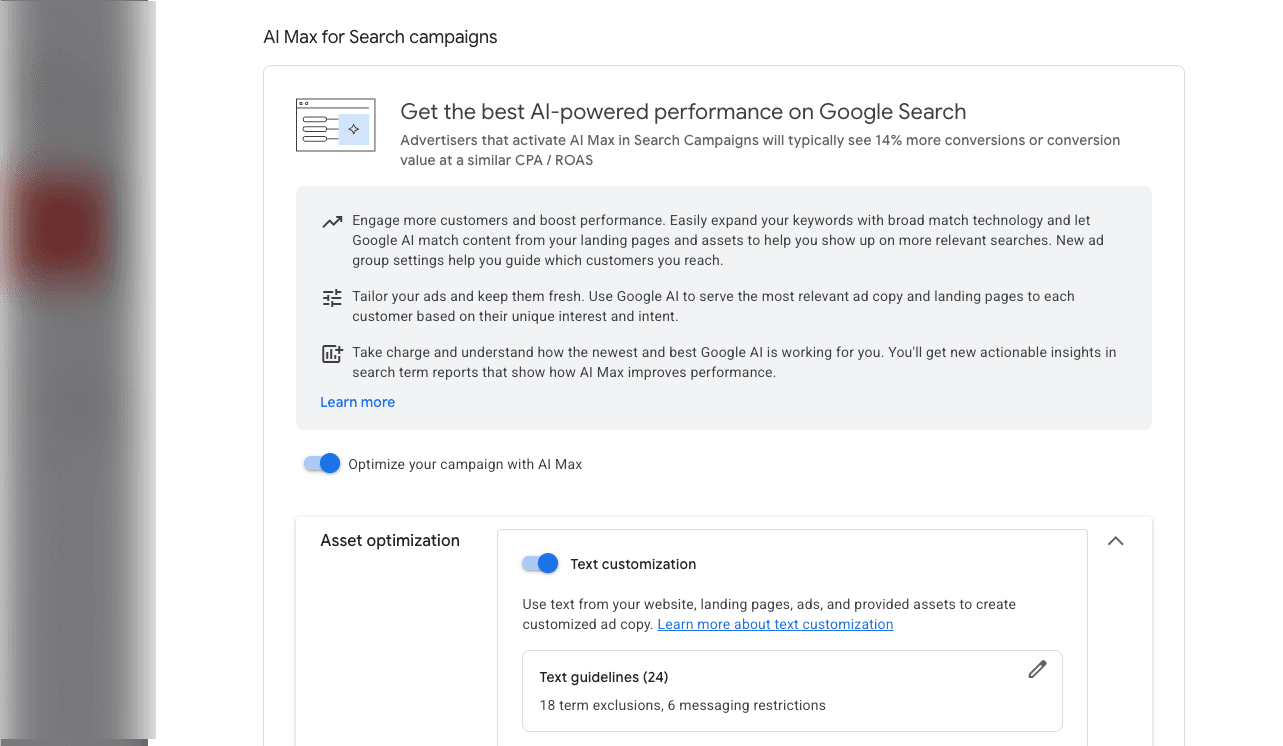
AI Max is easy to misread as another toggle in campaign settings. I believe that reading is too narrow.
AI Max is not a new campaign type. It is a layer on Search campaigns whose job is to make those campaigns flexible enough for AI-shaped results: AI Overviews, AI Mode and conversational search where the user needs a much more flexible experience than before.
What I am interested in is what AI Max and automatic campaigns represent for Google and for the panorama where paid media and AI search share the same demand.
Stop debating the feature. Start managing the mentality: open matching and creative for conversational demand, then draw a perimeter so the account still sounds like your business.
What AI Max is actually for
For AI Max to work, Google needs the account to give up two old certainties:
- Matching gets fuzzier. Keywords become signals. Conversations get compressed into thematic or synthetic keywords.
- Ads and URLs get flexible. Text and landing pages adapt so the response can sit inside the conversation, not only next to a static Exact match.
That is the mentality shift. Keywords stop being the hard target of the account. They become one intent signal among several: creatives, site, brand lists, exclusions, conversions.
If you still manage these campaigns with a 2019 Exact-match brain, AI Max will feel broken when, in reality, is doing a different job.
What automatic campaigns represent for Google
The future problem Google is trying to solve is to figure out how do ads stay relevant when demand looks like a dialogue?
When users ask long questions, refine them mid-conversation, or get answers inside AI surfaces, a campaign built only on fixed keywords, fixed text and fixed URLs is a bad fit. Automatic layers (AI Max on Search, the wider family of keywordless and generative behaviours, Performance Max) are how Google keeps paid inventory relevant in that world.
The panorama Google wants is clear: flexible campaigns for conversational demand. Automatic campaigns are how paid stays in the room when search stops looking like a keyword box.
What this represents for paid media in an AI world
For us, the risk is answering a structural shift with a checklist.
The useful framing is dual:
- Open: let matching, text and URLs flex enough to enter conversational and AI-shaped demand.
- Close: define brand, messaging and URL boundaries so the account still represents the business.
If you only open, you optimise for Google’s inventory problem. If you only close, you stay out of the experiment and loose market positioning.
AI Max is designed to step outside what you built. That is how it finds conversational queries. The same design means it does not know your legal limits, which pages sell nothing, or that inventing a price to win CTR is unacceptable. Automatic does not mean unsupervised. It means your control model has to move from keyword lists to a perimeter.
That dual job is the strategy and secondary features are where you implement it.
Why engaging with automation makes sense even when results are not always great
Google’s published success stories frame AI Max as an upside. Industry data is less tidy: ROAS results swing from positive to negative, as usual, depending heavily on the business, the account and other factors.
But I still want practitioners fluent in this system, because:
- Direction beats comfort. If a slice of demand is moving into conversations and AI surfaces, learning flexible campaigns now is cheaper than inventing a control model under pressure later.
- You can practice with a small blast radius. A deliberate pilot with a perimeter beats discovering automatic layers only when they are already shaping delivery.
Of course we should not trust the case studies blindly, we should get good at paid inside an AI search world while we still choose the pace.
The perimeter automatic campaigns need
Flexibility in AI Max stands on three legs.
Brand inclusions and exclusions
Tell the system which brands you will show for, and which you will not. Exclusions at campaign level. Inclusions at campaign or ad group. In case of conflict, the exclusion wins.
There is also the larger brand searches control: everything relevant, your own lists, or non-branded only.
Automatic matching loves brand traffic: yours and competitors’. That inflates generic campaigns, cannibalises brand campaigns, and wrecks incrementality. Brand control is how measurement stays honest when search term matching widens.

Text customisation and text guidelines
The system builds headlines and descriptions from your domain, landings, ads and keywords.
Your brief to the machine is text guidelines: up to 25 term exclusions, up to 40 messaging restrictions (no prices, B2B not B2C, no competitor names, and so on).
Without guidelines, automatic creative is a copywriter with no brief. But you still need to watch the end result very closely because google doesn't always listen.
Final URL expansion and URL exclusions
The system can change the final URL on your domain when it thinks another page will convert better. You should have URL exclusions always. Every website has URLs that are not transactional, those should be excluded every time.
Inventory before strategy
Strategy talk is cheap if you do not know what is already on.
If you have your Google Ads API active to an AI just ask across the MCC:
- Which campaigns already have AI Max on?
- Which have the guardrails (brand, text guidelines, URL exclusions)?
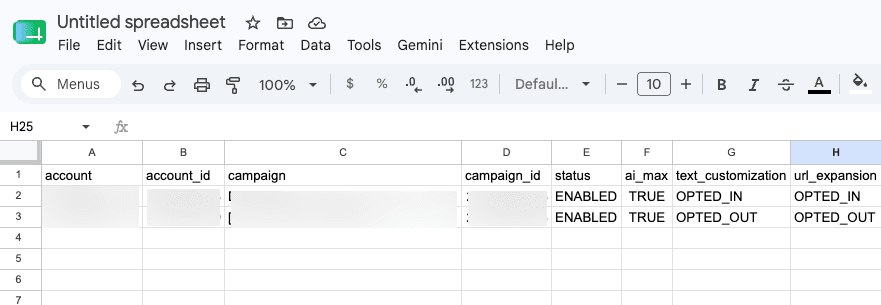
We ran that with an internal agent on client-labelled accounts and found two campaigns with AI Max on that we had not noticed. That is the panorama in miniature: automatic layers spread faster than attention.
No API? A Manager script to a Sheet is enough. Here is my Google Ads MCC Script or Google Ads single account script that you can copy and paste.
What “good” looks like
Do not turn everything on because automation is inevitable.
-
Treat automatic / AI Max campaigns as how paid meets conversational demand, not as random automation yo don't want to deal with.
-
For automated campaigns, make sure to setup the **perimeter **(exlusions) before you argue about performance.
-
Keep at least one deliberate pilot where you study search terms, generated assets and chosen landings on purpose.
-
Keep Performance Max and AI Max arguments about budget and query logic, not vibes and control.
Common questions
Frequently Asked Questions
- Is AI Max a new campaign type?
- No. It is a layer on Search campaigns you already have, built to make them flexible enough for conversational and AI-shaped demand.
- Is this “PMax for Search”?
- Related family, different goals. Shared mentality (intent signals + exclusions). Different reporting and controls.
- Do I need AI Max to show in AI Mode?
- Google’s public framing ties AI-shaped inventory to flexible setups (broader match, AI Max, Performance Max). Treat AI Max as a strategy to make standard Search ready for that world.
- What if I refuse the automatic model?
- You can still run tighter Search. Just be honest that a growing slice of demand is shaped for flexible campaigns, and that Google’s product path is making the old “never opted in” position thinner for many account structures.
- Where do text customisation and Final URL expansion fit?
- They often travel together when AI Max is enabled. Text guidelines and URL exclusions are how you keep that flexibility from rewriting your offer or parking traffic on pages that do not sell.
My point is
-
AI Max is a layer for conversational demand, not a campaign type.
-
Automatic campaigns are how Google keeps paid inside an AI search world.
-
Mentality shift: keywords are intent signals; ads and URLs need flexibility, control moves towards instructions and briefs.
-
Inventory your accounts. Silent automatic layers can make your strategy worthless.
Here is my Google Ads MCC script and my Google Ads single account script.