How advertising agencies can build effective targeted account lists
B2B buyers complete 70% of their research anonymously before talking to sales. Here is how agencies can use intent anomaly spikes to build targeted account lists before competitors arrive.


E-commerce vs B2B ABM
E-commerce is relatively straightforward: a consumer sees an advert, visits a site and may transact quickly. Business-to-business (B2B) account-based marketing (ABM) works differently. Buying cycles can last 6 to 24 months, and decisions are usually made by buying groups whose research is largely invisible until they contact a vendor.
The available statistics are striking. According to the 2023 B2B Buyer Experience Report published by 6sense on 11 December 2023, B2B buyers complete 70% of their online research anonymously before initiating contact with a vendor. The report also finds that 78% of buyers have already decided what they want and that 84% know which vendor they are going to choose before they make initial contact with a sales team. In other words, B2B buyers do almost all their research silently before talking to anyone. This means that if you are not visible during their research phase, it is highly unlikely that you will secure a deal. The big question is: how do you know who is researching and when? If you have this information, you can reach buyers at the right time so that, by the time they are ready to buy, you have been on their radar, and they are evaluating your products or services.
| B2B Buying Stage | Benchmark Metric | Commercial Implication |
|---|---|---|
| **Anonymous Online Research** | 70% | Initial buyer evaluations occur invisibly before vendor contact |
| **Requirements Decided in Advance** | 78% | Product criteria are locked before initial sales conversations |
| **Vendor Shortlist Pre-Selected** | 84% | Final choice is determined prior to direct sales engagement |
This means that if you are not visible during their research phase, it is highly unlikely that you will secure a deal.
Nate Burke
How do you know who’s researching and when?
The B2B ABM sector has long sought a reliable way to identify which companies are actively researching a product or service before those companies contact vendors. That need has encouraged technology firms to monitor and analyse intent data: aggregate signals that suggest a company is showing increased interest in a particular topic. To be useful, these firms must be able to monitor a wide range of companies and distinguish meaningful changes in research behaviour from normal background activity.
A simple analogy helps explain how this works. Imagine an observer watching bees across a large field. Most of the time, the bees move among many kinds of flowers. But if a noticeable number begin gathering around one patch and stay there longer than usual, the observer can reasonably infer that the patch is attracting unusual interest. Specialist intent data firms look for a similar shift at company level. They compare normal keyword-search activity with increases in activity around a specific topic, then consider signals such as the number of individuals researching it, research frequency, scroll time and page views before deciding whether the company is showing meaningful interest.
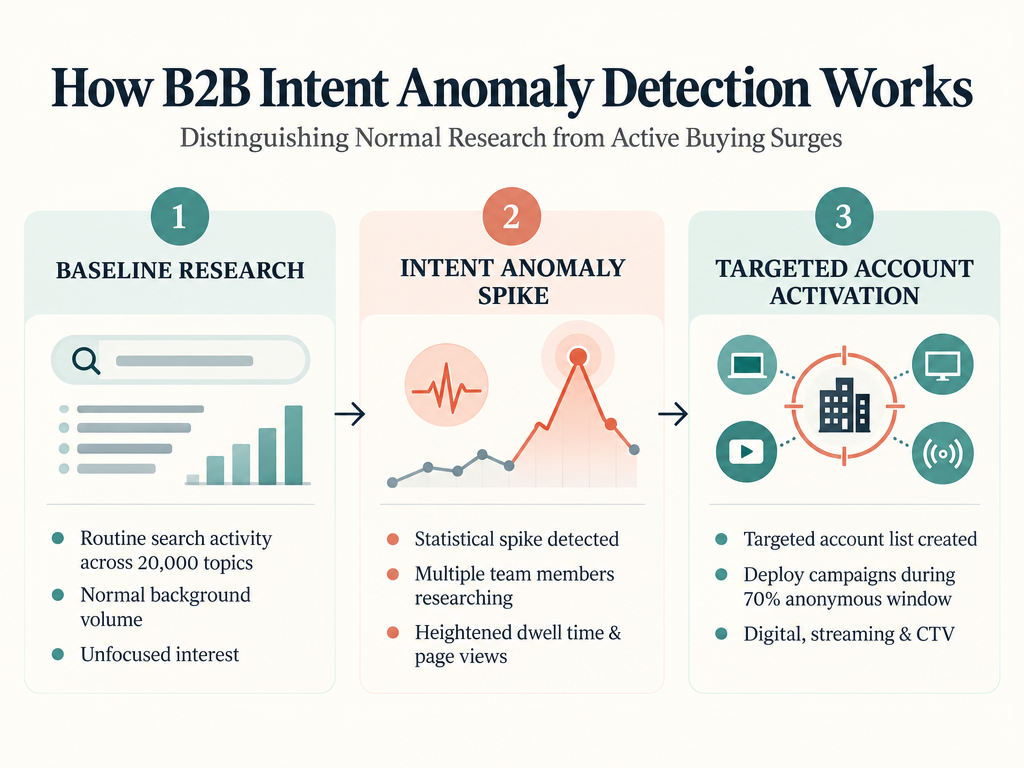
Bombora is a pioneering specialist firm that builds B2B audience and intent data. Its Data Co-op connects leading publishers, brand websites and premium data providers, giving it visibility across a wide range of accounts and intent sources. Using advanced AI models, Bombora monitors the aggregate research behaviour of accounts and compares it with normal activity across about 20,000 B2B topics. When it detects an unusual spike in interest, it can alert customers to accounts that may be moving into an active buying phase.
Bombora mainly serves large enterprise companies, and its services are not normally available to advertising agencies. Through Diginius’s partnership with Bombora, agencies can access Bombora’s audience and B2B intent data. We are disclosing that partnership so readers can evaluate the context clearly and decide which specialist B2B intent data provider best suits their needs.

How an agency can draw up a targeted account list
Suppose your client is a B2B vendor providing network security services. An agency could use “network security” as the topic for a B2B intent data specialist such as Bombora to monitor. The specialist would identify accounts showing a significant increase in research activity around that topic, creating a target list of companies that may be entering an active buying phase. This anomaly-detection approach is widely used by enterprise companies to identify potential leads.
With a targeted account list in hand, you can identify suitable publishers and media channels, from digital media and streaming platforms to connected TV (CTV), that are appropriate for those accounts. You can then advise your client to launch an advertising campaign early in the 6-to-24-month buying cycle, raising the visibility of the client’s network security services before buyers are ready to approach vendors.
A partner on the same journey
For the sake of disclosure, helping advertising agencies thrive is our core business. We help them identify which online marketing and sales channels are driving the best conversions, so they can act quickly, reduce wasted media spend and grow sales faster. We also give them access to specialist programmatic expertise, technology and operational capabilities without the cost and complexity of building those resources in-house. Through our free global agency partner programme, including a strong presence in the US, we support agencies and their clients in running more efficient B2B account-based marketing campaigns.
Sources & Further Reading
- 2023 B2B Buyer Experience Report (6sense)https://6sense.com/newsroom/84-of-b2b-deals-are-decided-before-marketers-even-know-about-them/