The click got easier to buy, and harder to understand
Same month, one account: Meta claimed 435 sales, GA4 gave it 104, Google Ads booked 1,464, GA4 counted 2,239. Four numbers, none agree and here is what to do now.

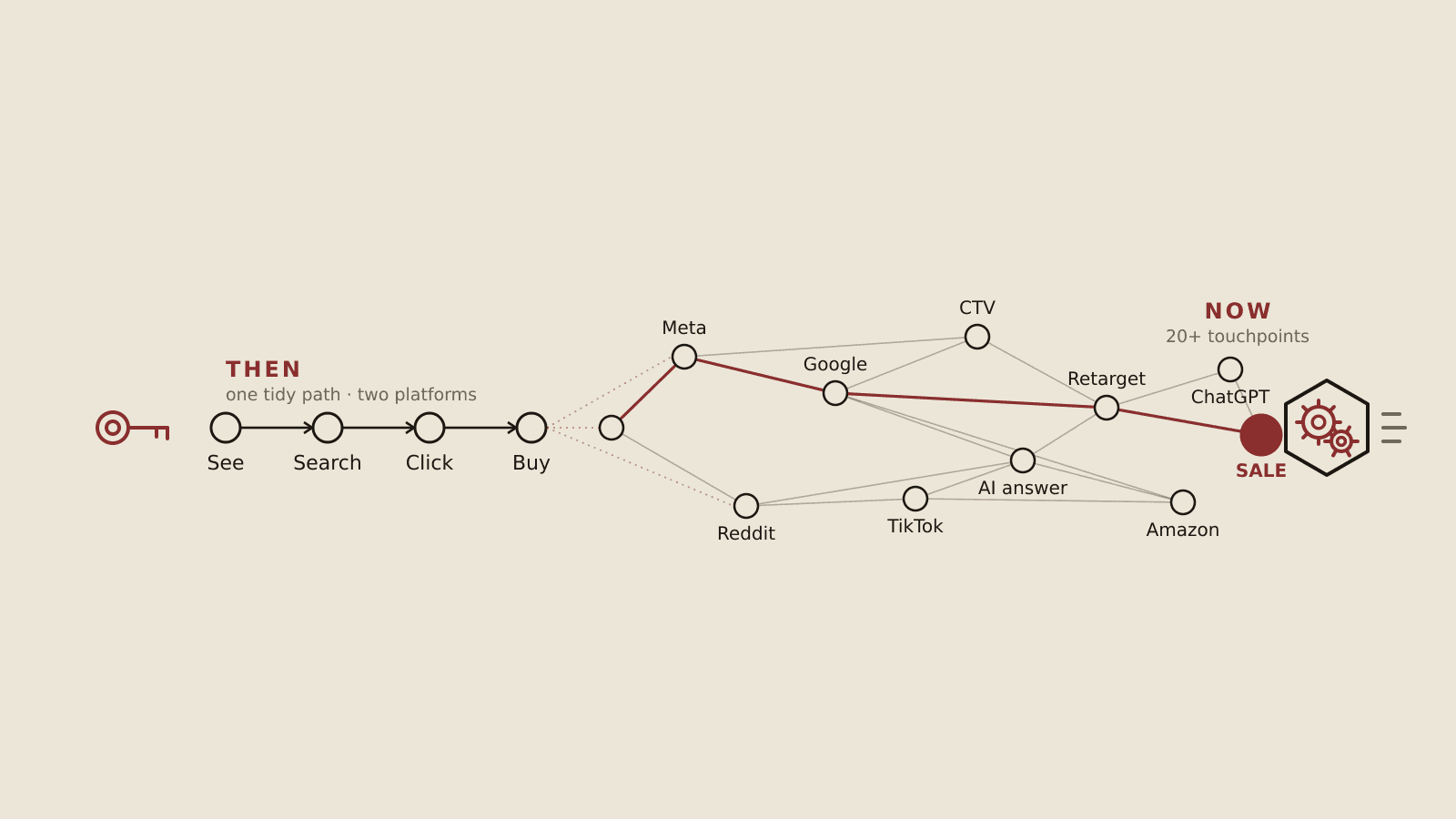
Five years ago, the job was tidy. Someone saw an ad on Meta, then went to Google the brand, clicked one ad, and bought. Four steps, two platforms, one cookie that followed the user nicely between them. Google captured the intent, Meta created the demand, and we could see the picture.
Our work at the time was manual precision. We picked exact and phrase keywords by hand. Built tight interest and lookalike lists. Set and moved bids manually. Added device, location and hour-of-day modifiers on top. The agency that won was the agency that was more diligent and more precise than the competition. Effort in, control out, this was the deal.
Measurement felt like truth for the same reason. Every platform counted its own conversions, the pixel fired stable, and ROAS came clean and per platform. And it felt correct, because the journeys really were short and trackable, signals were rich, and privacy friction was small.
The thing we did not notice: all this model was built on three assumptions, stable cookies, short journeys, and that each platform's own number can be trusted. And all three were going to fall down at the same time.
Five shifts came at the same time, and they feed each other
The journey broke into pieces. The straight line became like a pinball machine. Realistic path now: someone sees you on Facebook when he was not even shopping, after a few days he asks an AI assistant what to buy, then Googles it, then gets retargeted with an offer. This is four platforms for one sale, more than twenty touchpoints, many devices, weeks not minutes, and no two journeys are the same.
Search lost its single front door. "Search" before meant Google. Now Google still answers before it links; TikTok and Instagram are where younger buyers "look things up", Amazon is the first stop for a big part of product searches, and many people just read the AI answer. You can not own a list of Google keywords and say that the work is done. And more and more searches never leave the page at all, around 68% of US Google searches finished without a click in early 2026 (SparkToro/Datos). When an AI Overview answers on the spot, being named inside the answer starts to matter like ranking under it before.
- SparkToro / Datos, 2026 Zero-Click Search Study: 68% of US Google searches ended without a click in early 2026.
- Search Engine Land, "Google zero-click searches reach 68% in early 2026", https://searchengineland.com/google-zero-click-searches-2026-study-479717
We see much less than before. Here is an important thing that many people understand wrong: Google actually cancelled its Chrome third-party cookie deprecation in April 2025, and closed most of Privacy Sandbox till October 2025, but this did not give the signal back. Safari, Firefox and Brave still block third-party cookies by default (around one-fifth of traffic is already without cookies before Chrome does anything), iOS App Tracking Transparency killed a big part of app tracking, consent requirements became stricter, and pixels lose a real part of conversions. Retargeting pools became smaller, Meta lost visibility, and reported conversions went away from the real ones. The strategic result: your own first-party data becomes the most valuable asset that you have.
- Google, Privacy Sandbox update (22 April 2025), Chrome will keep third-party cookies and will not add a standalone user-choice prompt.
- eMarketer, "Google backs off third-party cookie ban", https://www.emarketer.com/content/google-backs-off-third-party-cookie-ban-amid-regulatory-pressure
- OneTrust, "Google drops plans for third-party cookie choice prompt in Chrome", https://www.onetrust.com/blog/google-drops-plans-for-third-party-cookie-choice-prompt-in-chrome/
- Privacy Sandbox APIs mostly wound down October 2025, https://www.consenteo.com/knowledge-hub/cookies/third_party_cookies_2026_after_google_reversal
Automation took the wheel. The manual levers were replaced by campaign types. Performance Max spreads the budget on every surface for one goal. Advantage+ finds the buyers; you only bring the creative. Smart Bidding sets the bids in every auction. And Google's AI Max, general availability from 15 April 2026, now takes the old campaign types inside: Automatically Created Assets and campaign-level broad match auto-upgrade to AI Max during September 2026, and Dynamic Search Ads go after them in February 2027 (Google moved this date from the original September after feedback from advertisers about Q4). The dials that we turned before now sit inside a black box.
- Google Ads & Commerce Blog, "Dynamic Search Ads are upgrading to AI Max" (11 June 2026) , https://blog.google/products/ads-commerce/dsa-upgrade-to-ai-max-2026/
- Search Engine Land, "Google sets AI Max migration timeline for Search campaigns" , https://searchengineland.com/google-sets-ai-max-migration-timeline-for-search-campaigns-485006
Creative became the new targeting. When the AI chooses the audience, the ad itself is the one big lever that stays in your hands. Give the machine strong creative, and it finds the right people; give it weak creative and no clever targeting will save it. Volume, variety and a native format for every platform now drive the performance directly.
Here is the part I really want to land. These five things are not separate trends that you solve one by one. They are a loop. Less signal makes more automation. More automation makes creative and data the only real inputs that we control. And all this happens on a journey that we can not fully see. They do not sum, they multiply.
The new deal that we all signed
Control went down, now we steer, we do not operate. Reach and efficiency went up; AI scales far better than we ever could by hand. Transparency went down, these are black boxes that check their own homework. It is not good or bad. It is simply the world where every account lives now, and it means our value moves to the parts that the machine can not do.

Why the reports lie to you now
Take one account, one month, 28 July to 26 August 2026, and ask each system how many sales it drove. Meta Ads Manager says 435 purchases. GA4, on last-click, credits Meta with only 104. Google Ads books 1,464 conversions for the same window, while GA4 gives Google 2,239 purchases. Four numbers, same month, same account, and they can not all be true.
| Same account · 28 Jul to 26 Aug 2026 | Reported sales |
|---|---|
| Meta Ads Manager | 435 purchases |
| GA4, (meta / cpc) | 104 purchases |
| Google Ads | 1,464 purchases |
| GA4, (google / cpc) | 2,239 purchases |
Source: Meta Ads Manager, Google Ads, GA4, 28 Jul to 26 Aug 2026.
Meta alone claims more than four times what GA4 will give it, and the two Google numbers do not agree with each other either. Nobody is lying on purpose. Every platform counts with its own rules and takes credit for a touch it only partly saw: Meta on a view inside its window, Google on a cross-device logged-in match, GA4 on the last click. But you can not run a business on numbers that disagree this much, and data-driven attribution does not fix it, it only moves the credit around inside Google.
This is also why a channel like brand search looks like a hero. On the same account, brand search shows 20.55x: about £3,900 of spend turned into nearly £80,000. So the obvious decision is "just put all the money in brand search", yes? But the demand was created in another place. People searched the brand only because something higher in the funnel, mostly Meta, put it in their head first. Brand search did not create these sales, it only collected them. Cut the top of the funnel and that 20.55x dries out.
| Brand search · same account · 28 Jul to 26 Aug 2026 | Value |
|---|---|
| Spend | £3,880 |
| Revenue | £79,741 |
| Reported ROAS | 20.55x |
Source: Google Ads, 28 Jul to 26 Aug 2026.
Brand search is a mirror, not an engine. The return looks great, but alone it is a bad growth strategy.
Few words to defend the black box
To be honest with the machines: automation really delivers. On the same account, one Performance Max campaign turned £103,577 into £1,023,125, a 9.88x return, on a campaign where the human chooses almost nothing. Honestly, better than most of us would do by hand.
| Performance Max · single campaign · 28 Jul to 26 Aug 2026 | Value |
|---|---|
| Spend | £103,577 |
| Revenue | £1,023,125 |
| Reported ROAS | 9.88x |
| Human input | budget and guardrails only |
Source: Google Ads, 28 Jul to 26 Aug 2026.
But it is blind. You can not fully see where the money went, you can not easily separate prospecting from remarketing, it will happily spend on your brand and call this a win, and when it drifts you understand it too late. So the job is not to operate it. The job is to watch it, to question it, and to feed it.
The numbers that matter now
Three, and all of them are business-level, not platform-level:
- Blended ROAS / MER , total revenue ÷ total spend. It ignores the platform self-reporting and shows the whole picture.
- Incrementality, did the ad really cause the sale? Holdout and geo-lift tests answer this, and this year they became mainstream.
- Blended CAC, how much it really costs to win a customer across everything. This is the number that finance trusts.
The change in one line: stop asking "what did each platform report?" and start to ask "did we grow, and how much did this growth cost?"
Same job title, but different craft
The specialists from 2022 picked keywords and audiences, moved bids all day, trusted each platform's own siloed reports, and optimised inside one platform. The strategist from 2026 sets goals, guardrails and budgets, feeds clean data and signals, briefs and judges creative on volume, and measures across all the business. My own time moved the same way. The manual keyword and bid work shrank to a small part of the week, and creative, measurement and strategy took the rest.
How PPC specialists survive this, and what to focus on with clients
The pivot in one line: stop renting clicks, start owning the journey. The media-buying itself becomes like plumbing, the platforms will do it better than you by hand. What keeps you (and your agency) valuable is everything that the machine can not do. If you ask yourself where to put your hours now, and what to lead with in every client conversation, this is it:
Become the person who tells the client the truth that the platforms will not tell. Measurement is where you win or lose the client. In one month on the same account, Meta claimed 435 sales while GA4 gave Meta 104, so the honest figure only appears when you blend the platforms yourself. Lead every report with blended ROAS/MER and blended CAC, not with the platform-reported numbers, and become really fluent in incrementality: geo-lift, holdouts, brand-exclusion tests. This is how you prove what really drove the growth. A client who trusts your numbers more than Google's dashboard is a client who does not leave.
Own the data pipeline. When the third-party signal continues to disappear, the client's own first-party data is what feeds the machines and makes the automation work. Enhanced conversions, server-side / CAPI tracking, growth of Customer Match lists, zero-party data, and clean consent so everything is usable. A data-health and tracking audit is the fastest and most sellable thing that you can put in front of a client this quarter, and it lifts everything after it.
Run creative like a production line. This is the one lever that the AI can not pull for you. Volume instead of one hero ad, native formats for every platform, structured testing of hooks and angles, AI-assisted production but always on-brief and with human review, and fast refresh to beat the fatigue. For many clients, this is a resourcing conversation, so it is a performance unlock and also an upsell.
Defend the full funnel with proof. When the signal becomes unclear, everybody runs back to brand search and bottom-of-funnel because it "converts". Short-term ROAS looks great; long-term growth slowly stops. Your job is to protect top-of-funnel and to justify it by incrementality, not by self-reported ROAS, the demand that you create today is the branded search of tomorrow.
Go where the buyers really are. The one-front-door era is finished. Microsoft/Copilot for cheaper efficiency, retail media for closed-loop data, connected TV for shoppable brand, and ChatGPT ads while it is still early. Bringing a client there before their competitors is the move that positions you as a strategist, not a button-pusher.
Win the AI answer (Generative Engine Optimisation and Answer Engine Optimisation: GEO / AEO). If the AI answers before anybody clicks, the goal is to be the brand that it names. Track visibility in AI Overviews and ChatGPT, structure content and feeds so the models can cite you, and treat "AI visibility" like a new channel next to paid, and also a natural new service line.
Manage the machines; do not obey them. Automation is not optional, so the skill becomes control-by-input: guardrails on PMax and AI Max (brand exclusions, geo and audience limits, budget caps), clean signals (values, offline conversions, first-party data) so the AI optimises to a real profit, targets that reflect the business reality because it does exactly what you tell it, and always keep the scepticism about spend drift, brand cannibalisation and self-reported wins.
Nothing from this is a button in the interface. And this is exactly the point, this is the work that survives the automation, and this is exactly where an expert wins against a client who tries to do it alone.
In one line
The click got easier to buy and much harder to understand. The media-buying becomes plumbing; the value now sits in the things around it, the data, the creative, the measurement, and steering the machines better than the next person. So this is the product now: clarity, not clicks.