Broad Match Works. But Is That Really Enough?
Two groups of searches containing the same search modifier produced very different conversion rates but surprisingly similar CPAs. Here’s why hitting your Target CPA or ROAS can hide opportunities to improve efficiency.

I’ve been sceptical of Broad Match for a long time.
That’s not because I believe it can never work. I don’t know everything, I haven’t looked inside every Google Ads account and I’m certainly not going to tell someone getting exceptional results from Broad Match to stop using it because my experience has been different.
But in the accounts I have worked on, I’ve yet to look through the search terms generated by Broad Match and come away thinking there was nothing we could improve. Sometimes that means excluding searches that simply aren’t relevant. More often, the bigger opportunity comes from looking beyond whether a search converted and understanding which searches are actually producing the best results for the business.
That’s why I think asking whether Broad Match “works” sets the bar too low.
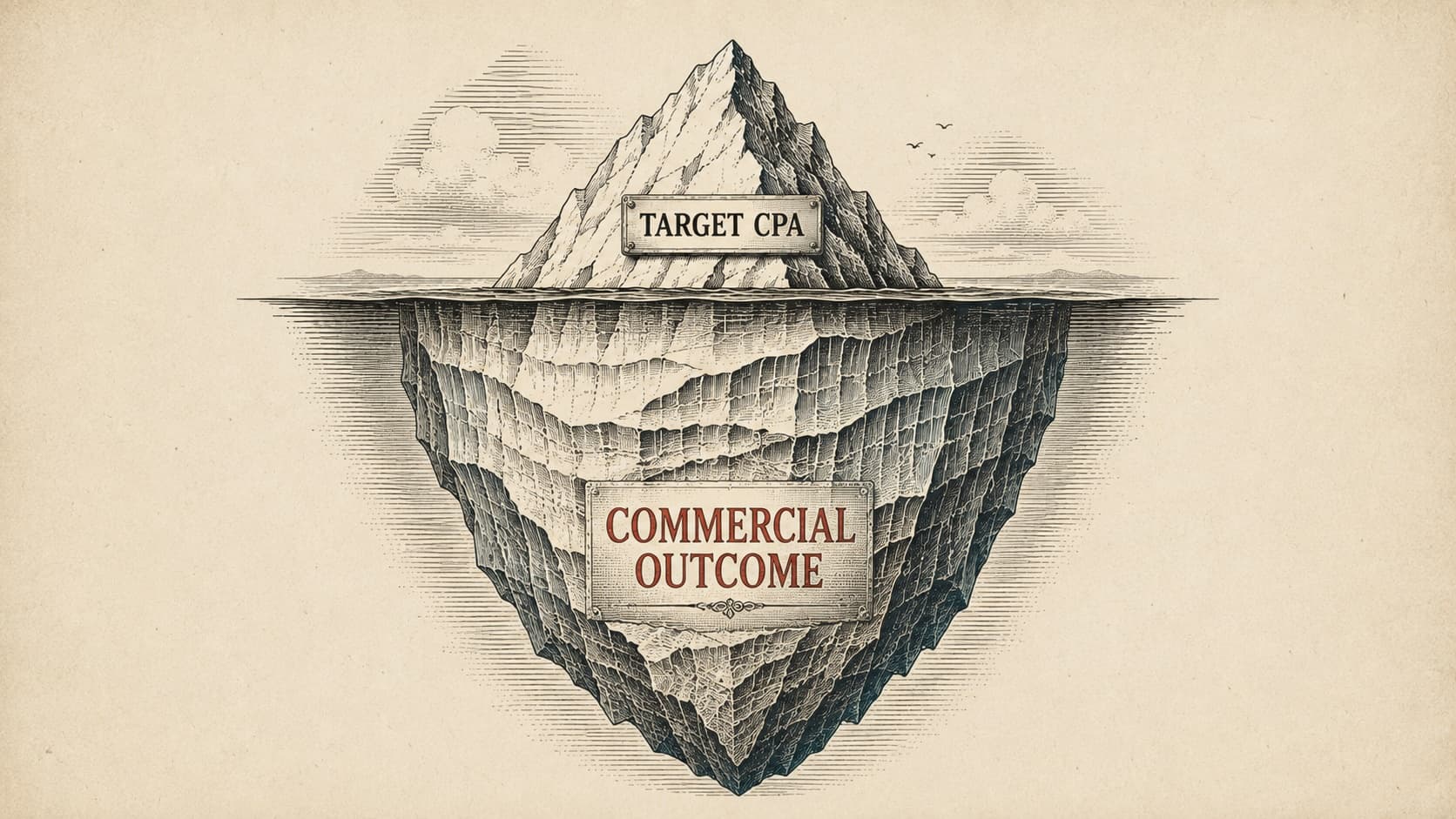
If you ask Google to generate leads at a £50 CPA and Broad Match delivers them at £48, you can call that successful. Google has achieved the target you gave it and the business may be perfectly happy with the result.
But that £48 doesn’t tell you whether you could have generated those leads for £40. It doesn’t tell you whether some of the searches you paid for were irrelevant, whether others produced much better quality leads or whether some of that budget could have generated more value somewhere else.
Hitting a target and running an efficient account aren’t necessarily the same thing.
What does “works” actually mean?
A lot of the discussion around Broad Match seems to end up in one of two camps. Broad Match works or Broad Match doesn’t work.
I don’t think either is particularly useful.
A campaign can spend £10,000, generate 200 conversions at £50 each against a £55 Target CPA and objectively be doing what you’ve asked it to do. But if a meaningful proportion of that £10,000 was spent on searches that were irrelevant, poor quality or commercially less valuable, I’d struggle to call that exceptional performance.
And that distinction becomes even more important when budget is limited. Every pound spent on a search that adds little value is a pound that isn’t available for a better search, another campaign or potentially another channel entirely.
That’s why I’m much more interested in what’s happening underneath the headline CPA or ROAS.
Broad Match doesn’t need to be “crap” for there to be an opportunity to improve it. In fact, it may be doing exactly what it was designed to do: using the information and signals available to find enough conversions at a cost that satisfies the target you gave it.
The question for the advertiser is whether that’s good enough.
Look at what you’re actually paying for
One of the simplest things you can do is spend some time in the search terms report. I’ve yet to work on an account where I couldn’t fairly quickly find opportunities there. Sometimes it’s the obvious stuff: searches that simply aren’t relevant to the business and can be excluded. But that’s really only the first layer.
The more interesting work starts when you look at the searches that are relevant and ask whether they should really be treated equally. A search doesn’t automatically become good because it generated a conversion and two searches relating to exactly the same product can represent very different levels of intent.
| Product / Vertical | Research / Exploring | Commercial Intent |
|---|---|---|
| Car Finance | “car finance calculator” | “apply for car finance online” |
| Van Insurance | “average cost for van insurance” | “van insurance quote” |
| Mortgages | “how do mortgages work” | “apply for mortgage” |
None of the searches on the left are irrelevant. They’re all perfectly reasonable searches for businesses offering those products to appear for. But compare them with the searches on the right and the likely difference in commercial intent is clear.
Broad Match and Smart Bidding will, of course, consider far more than the words in the search. Google can use other signals, previous search activity and the likelihood of a conversion when deciding whether to enter an auction and how much to bid. But ultimately, if the system can include searches from both sides of that table and still achieve the Target CPA or Target ROAS you’ve given it, it may be doing exactly what you asked it to do.
That doesn’t necessarily mean it’s the most efficient mix of traffic for the business.
Google may be perfectly happy generating enough conversions or conversion value across those searches to achieve the overall target. Our job is to go further and understand whether particular types of searches consistently convert better, produce more qualified leads or ultimately create more valuable customers.
That also means we shouldn’t simply assume that the searches on the right will always perform better. The data might tell us something completely different. The important point is that hitting the bidding target doesn’t remove our responsibility to look for opportunities beyond it.
And this is where search term analysis becomes much more interesting than simply finding irrelevant searches to exclude. Once you’ve cleared out the obvious waste, you can start understanding which types of relevant searches actually produce the best results and use that information to improve the account further.
If we stop our analysis at “it converted”, we potentially miss all of that. There’s a progression from relevance, to conversion, to lead quality and ultimately to commercial value. The further we can connect our paid media decisions along that journey, the better the decisions we can make.
Search intent is only one part of this. Even when the language looks remarkably similar, performance can change depending on the context in which that search appears. The same word or modifier can behave very differently across products, campaign themes or audiences, which is another reason why broad averages can hide useful information.
Small differences in searches can produce very different results
This isn’t only about separating research-led searches from those that appear more commercial. Sometimes the differences are much less obvious.
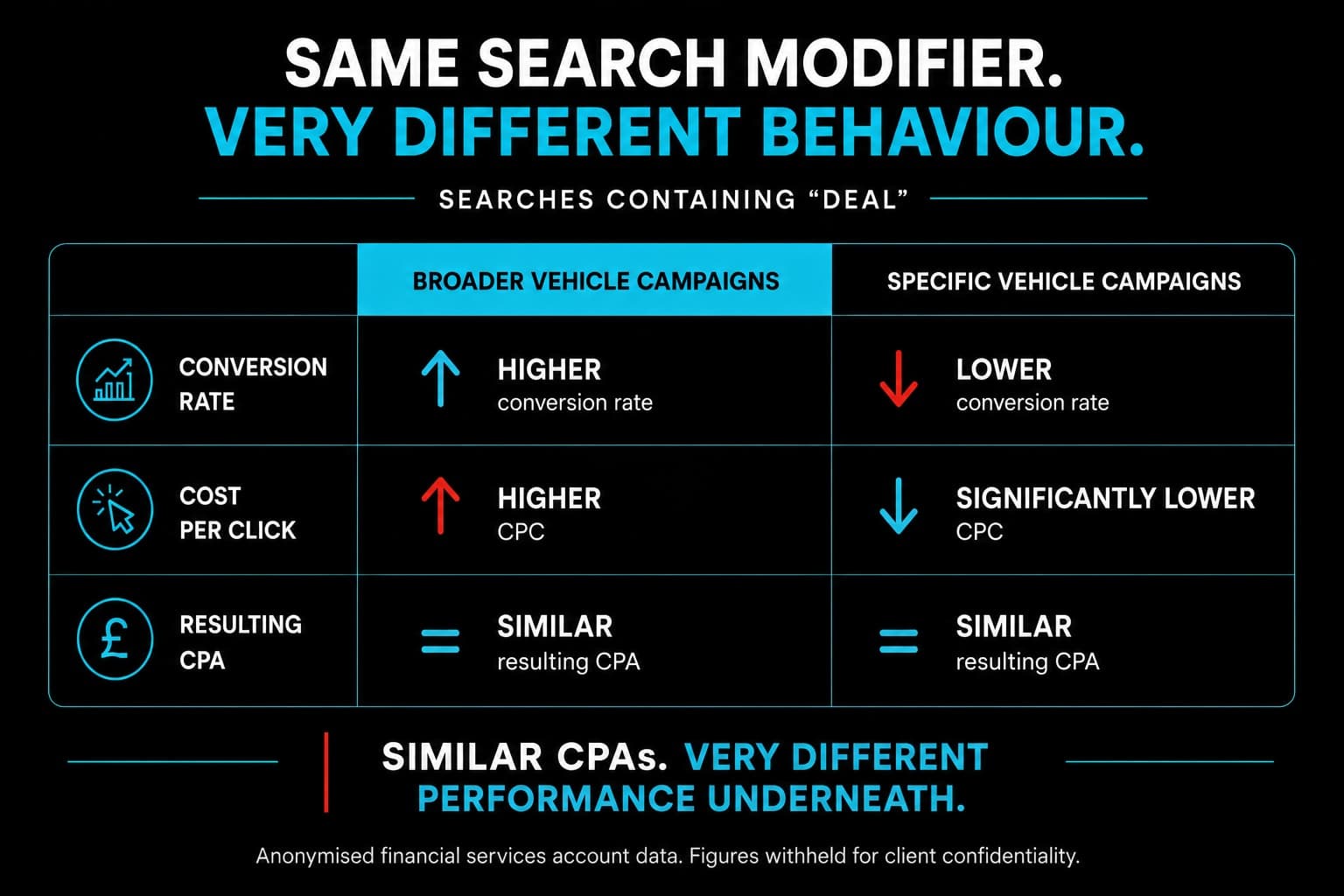
I saw a good example of this recently while analysing a financial services account. Searches containing the word “deal” appeared across campaigns targeting broader vehicle searches and campaigns built around specific vehicle types. On the surface, you could reasonably group those searches together and make a judgement about whether “deal” was a useful modifier.
Once we separated them, they behaved very differently.
In the broader vehicle campaigns, searches containing “deal” converted at close to 10%. In the specific vehicle campaigns, the conversion rate was closer to 4%. However, the clicks in those specific campaigns were substantially cheaper, meaning the resulting CPAs ended up relatively close.
If we’d stopped at CPA, there wasn’t much to see.
Digging further showed two very different patterns of behaviour. And the answer wasn’t simply to decide that “deal” was either a good or bad search modifier. It gave us something to investigate, structure and test differently.
There’s another important point here: neither example was using Broad Match. The campaigns were using Exact Match.
Exact Match certainly isn’t the Exact Match many of us managed years ago. Close variants and Google’s interpretation of intent mean even Exact Match keywords can trigger searches you might not have expected from looking at the keyword sitting in the account.
If we can find this much variation underneath Exact Match, there’s even more reason to interrogate Broad Match when Google has considerably more freedom over which searches we appear for.

Automation can hide inefficiency
There are good reasons why Google has moved towards greater automation.
People search in an enormous variety of ways and Broad Match can identify valuable searches you may never have thought to target manually. Combine that with Smart Bidding and the number of signals Google can process for every auction and there are decisions being made at a scale no PPC manager could realistically replicate manually.
That can be incredibly useful.
Handing over more of the decision-making shouldn’t mean we become less interested in the decisions being made.
One of the dangers of looking only at overall automated bidding performance is that good performance in one area can mask weaker performance elsewhere. Some searches can perform incredibly efficiently while others perform considerably worse and the campaign can still achieve its overall Target CPA or ROAS.
From the bidding system’s perspective, that may be perfectly acceptable. It was given an objective and achieved it. From the business’s perspective, there may still be money being left on the table.
That’s why I don’t see automation as a reason to spend less time understanding search terms. If anything, the more freedom we give the platform to make decisions with our money, the more important it becomes to understand the outcome of those decisions.
Your target isn’t necessarily the best result available
There’s another assumption underneath all of this that I think is worth challenging.
Why should the Target CPA or Target ROAS we’ve given Google automatically become our definition of success?
If a business knows it can profitably acquire a customer at £100, then setting a £100 Target CPA may be entirely sensible. But if better targeting, deeper search-term analysis and improved conversion signals allow us to acquire the same quality and volume of customers for £75, I don’t want to spend £100 simply because the business can afford to.
Targets should help us manage towards commercial objectives. They shouldn’t become permission to stop looking for efficiency.
Dez Calton
That £25 difference matters. Across hundreds or thousands of acquisitions, it becomes budget that can be reinvested into generating more customers, testing new opportunities or growing another part of the business.
Efficiency isn’t simply about making the CPA number smaller either. There may be situations where I’d happily pay a higher CPA for customers who generate significantly greater value. The objective is to understand what the business gets back for the money it invests and then allocate that money accordingly.
That’s a considerably higher standard than simply asking whether Google hit the number we gave it.

Google’s objectives and yours aren’t identical
I also think it’s healthy to remember who is making many of these recommendations.
Google is an extraordinary advertising platform and I’ve built a large part of my career using it to generate growth for businesses. Google also has shareholders, revenue targets and its own commercial objectives.
Those two things can both be true.
Google wants advertisers to succeed. If businesses continually lose money using Google Ads, eventually they stop spending money with Google. But Google also benefits when advertisers spend more through its platform. Our interests therefore overlap, but they aren’t identical.
If Google develops technology that allows an advertiser to profitably scale from £100,000 to £200,000, both businesses can win. But the advertiser’s job is still to determine whether that next pound is generating the best return available, not simply whether Google can find somewhere to spend it within an acceptable target.
That’s particularly worth remembering when the recommendation involves giving the platform more freedom over which auctions your money enters.
This isn’t an argument to turn Broad Match off
I’m not suggesting everyone reading this should now open Google Ads and pause every Broad Match keyword.
One size fits none.
The right approach depends on the account, market, conversion data, budget, search volume, commercial objectives and ultimately what your own results tell you.
I’ve got no problem with somebody telling me Broad Match works brilliantly for them. If you’ve tested it properly, understand the searches you’re paying for and it’s producing the strongest commercial outcome, keep using it. I’d be far more concerned if somebody stopped using something that worked because an article told them they should.
Equally, don’t use Broad Match simply because Google recommends it, because it’s increasingly the accepted approach or because somebody showed you a screenshot of an account where it worked.
Test it. Look underneath the headline numbers. Understand what you’re buying and what happens to those conversions after they leave Google Ads.
You might prove me completely wrong about Broad Match in your account. That’s considerably more useful than either of us assuming we’re right.
Is “it works” really the standard?
There are plenty of advertisers who will tell you Broad Match works brilliantly for them. Given the right data and conditions, Google can use very broad targeting to generate results that satisfy the targets it has been given.
But I’m not interested in settling for acceptable. I want exceptional.
I want to know what we paid for, which searches created value, where money was wasted, what happened to the customers we acquired and whether the same investment could have produced a better commercial outcome somewhere else.
So the next time somebody tells you their Broad Match campaign is working, there’s no need to tell them they’re wrong.
They may be absolutely right.
I’d just ask one more question:
Could it be working better?