I went looking for a context hints 'hack' on ChatGPT Ads. Here is what I found.
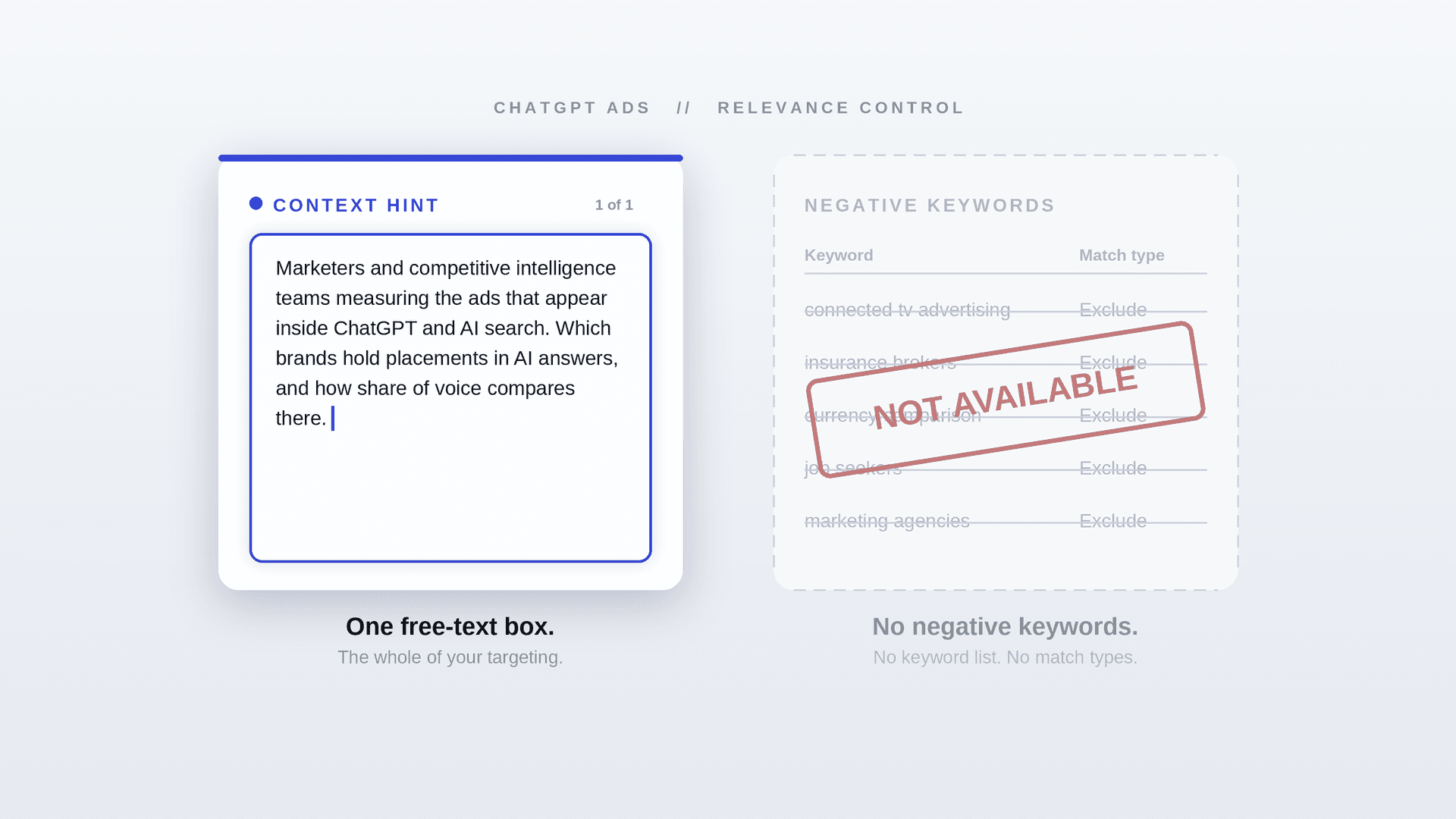
There is no secret "hack" for stopping ChatGPT ads serving against irrelevant conversations, because there are no negative keywords and it appears the only lever is one free-text context hint. This is a real before-and-after of what happened when I rewrote mine on a live account

Setting the scene
I’m a very lucky Product Marketing Manager. I get to play with a brand new ads platform (ChatGPT Ads) with a little bit of testing (or let's be honest, FAFO) budget, and I get access to Adthena indexed data both in a productised view and behind the scenes 'secret sauce' kind of way.
Imagine my face though when I review Adthena’s ad-matched-prompt data and see Adthena serving ads in ChatGPT against "best connected tv advertising" and "channel 4 vs itv advertising." Another mismatch was a prompt comparing three UK life insurance brokers. Nothing says "credible search intelligence platform" quite like turning up uninvited in a chat about income protection.
It’s almost funny for about ten seconds, and then you remember these conversations happen, and that type of intent mismatch is costing us actual ad bucks and leads to a first impression we would rather not make.
Nothing says "credible search intelligence platform" quite like turning up uninvited in a chat about income protection.
So you reach for negative keywords, right?
Get out of here you Adwords loyalist.
There are zero negative keywords here. There is no keyword list at all in fact. You have one free-text context hint where you describe the conversations you wish to appear in and a semantic model decides the rest. This model does read your hint, your ad title, copy, landing page and live conversation, it then makes a judgement call about relevance.
That’s a solid way of working in this new era of conversational and intent driven search compared to the ‘old’ keyword methods. It’s solid, right up until the model spots the word ‘advertising’ in my hint and lunges at every advertising conversation like a seagull to a dropped bag of chips.
Connected TV? Yes that is advertising. Channel 4 versus ITV? Also advertising. Not saying it’s wrong, exactly. It is just enthusiastically, expensively literal. It’s also not anchored onto one word, and not really paying attention to the rest of my context hint.
I am no master on why it behaves in this manner, and please use a big pinch of skepticism for anyone who says they do! My working theory however is that broad context hints hand the model too many doorways, and it walks through all of them, even the doors to other advertisers industries.

The test
Very simply, I changed my context hint, and reviewed what prompts I appeared for pre and post change. My old context hint was a bit of a greatest hits compilation.
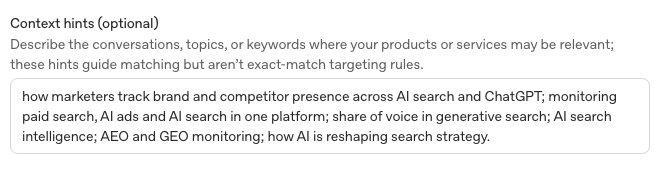
Paid search monitoring, AI ads, AI search, share of voice, AEO, GEO, and a closing line about how AI is reshaping search strategy. Six or seven distinct ideas crammed into one context hint. Every one of them a separate door. It's a mess, (which hurts to say as a self-diagnosed perfectionist).
So the test, run cleanly, with only one variable. I left the ad title, copy and landing page untouched and only rewrote the context hint.
Instead of a list, I distilled it to a single idea: measuring the advertising which appeared inside ChatGPT and AI Search, whose brands and competitors have placements in AI answers and how your own share of voice compares in that specific surface. I made this only one door, and bricked up the rest. I even added a line saying, in effect, this is not about advertising in any other channel, and not about comparing products or agencies in unrelated industries.
My new context hint in full:
“A marketer, brand, or competitive intelligence team trying to see and measure the advertising that appears inside ChatGPT and AI search results: which brands and competitors have sponsored placements in AI assistant answers, how their own ad presence and share of voice compares within ChatGPT and generative search specifically, and how to monitor and benchmark competitor ad activity in AI search. This is about advertising visibility inside AI chat assistants and AI search, not advertising in any other channel, and not about comparing or buying products, services, or agencies in unrelated industries.”
I then measured the change with Adthena data, which yes feels a little like marking my own homework, but if you’ve got it, flaunt it!
The results
The after picture is encouraging. All the off-brand prompts I had flagged were gone. No connected TV stuff and no insurance brokers, all gone! What remained concentrated hard on the AI Search topic I was aiming for. Better still, a new prompt appeared which I could not have scripted more neatly if I tried "best chatgpt ads monitoring tool."
That’s about as close to the bullseye as this gets. The hint change clearly reshaped what I served against, and in the intended direction.
I think the most interesting thing here is not my prompt list. It’s what the test says about advertising inside LLMs. We have spent years and years learning to steer search with keywords, match types and negatives. That entire approach does not work here. The lever is a paragraph of plain language and a model’s interpretation of it in conjunction with your ad copy and landing page.
Writing a good context hint looks a lot less like traditional media buying and more like writing a very precise brief for a very literal intern or junior marketer who might go ahead and do exactly what you said, but nothing that you meant.
Should my take hold, the skill that matters here is not bidding. It’s describing intent so exactly that the model cannot misread it. That sounds like a copywriting problem wearing a media-buying hat.
Sources & Further Reading
- OpenAI - Ads in ChatGPT: The Basicshttps://help.openai.com/en/articles/20001207-ads-in-chatgpt-the-basics