Master the Search Page: How I Am Combining SEO and PPC to Maximise Visibility while Slashing Budget Waste
We ran a split test on brand terms across a 120k-session account and increased Combined SERP CTR (SEO+PPC) by 10.4%. Here is what we found.

I’ve been in SEO for 15 years. And I’ve been launching and managing Google Ads campaigns for around 10 years. And there is one thing that has always driven me mad: watching SEO and PPC advertising run in separate silos with isolated budgets, disconnected reporting, and competing KPIs.
When you treat these as distinct channels, you leave high-value search real estate on the table and burn through ad spend on queries that could be handled far more efficiently. Yep, truth hurts.
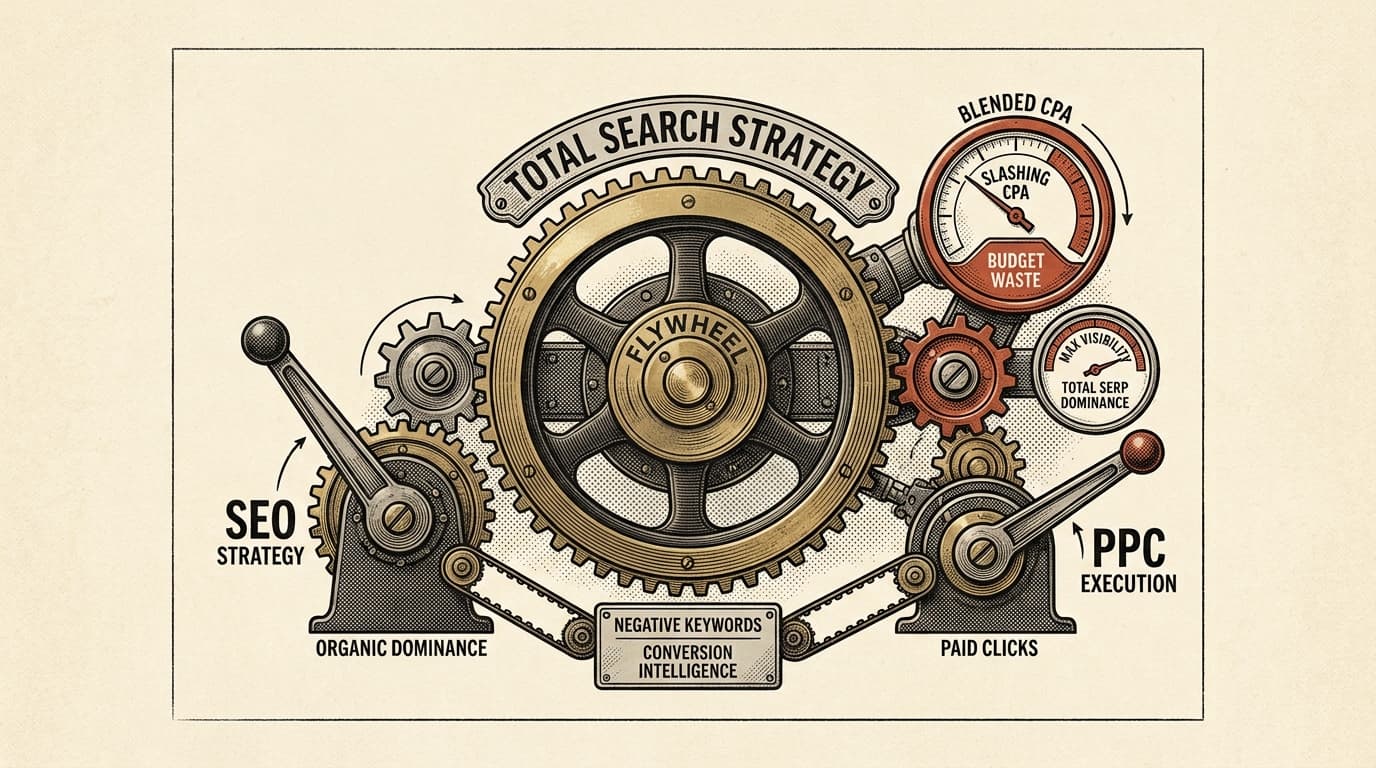
To win on modern SERPs, we have to adopt a Total Search Strategy, a unified framework that aligns organic strategy with paid execution. Here is how forcing SEO and PPC to work as a single performance flywheel transformed our search marketing from two isolated tactics into a high-margin growth engine.
1. Real Account Proof: Total SERP Dominance (Without Wasting Spend)
The biggest myth I battle in client meetings is the fear of cannibalisation, the idea that paying for a brand click when you rank #1 organically is money down the drain.
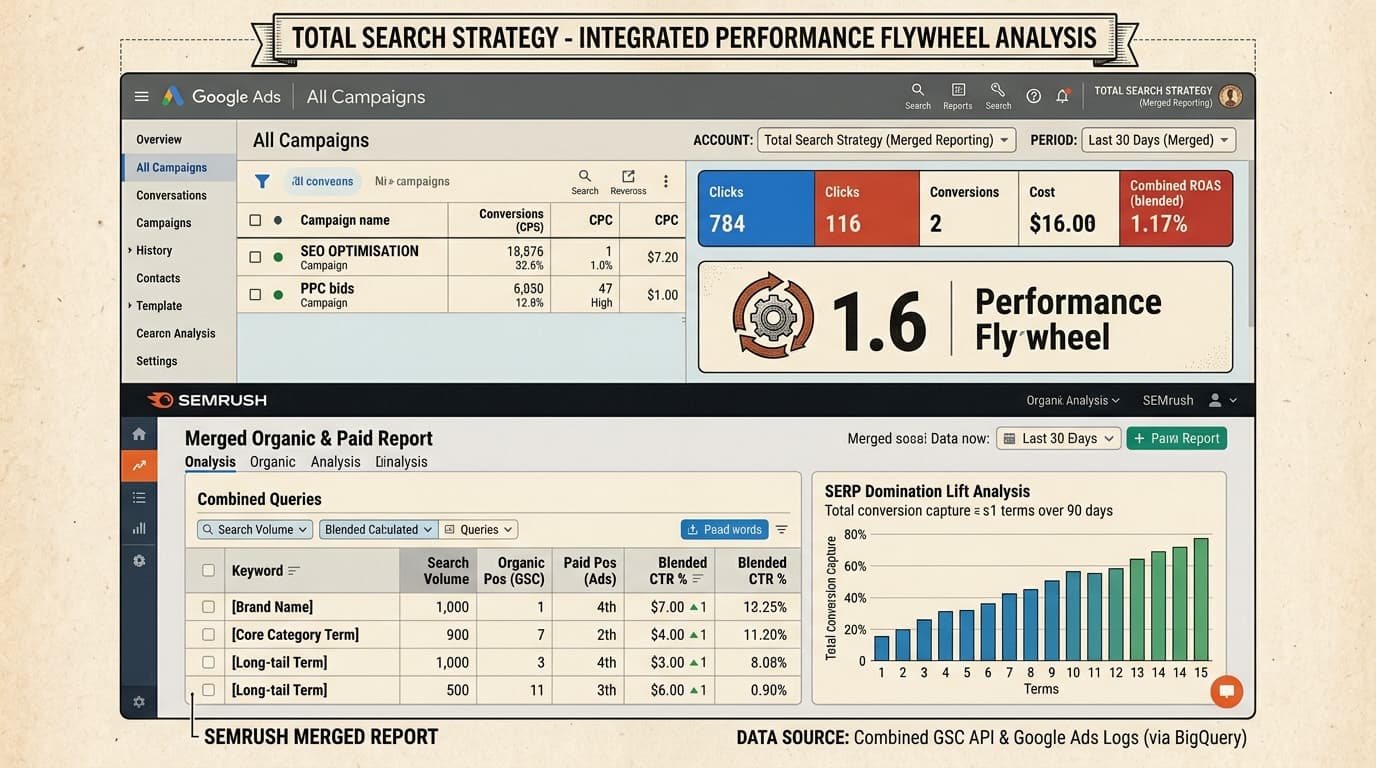
On a major e-commerce account handling ~120,000 monthly search sessions, we ran a 90-day split test on 15 core brand terms. For 45 days, we paused paid brand ads on queries where we held the top organic position. For the next 45 days, we ran top-of-page paid brand ads over our #1 organic listing.
Here is what the numbers actually showed:
| Metric | Organic Only | Combined (Paid + Organic) | Difference |
|---|---|---|---|
| Organic CTR | 58.0% | 41.2% | -16.8% |
| Paid Ads CTR | - | 27.2% | +27.2% |
| Combined SERP CTR | 58.0% | 68.4% | +10.4% Net Lift |
| Brand Conversion Rate | 3.2% | 4.1% | +0.9% |
Yes, organic branded traffic dropped by ~17% when paid ads were active. But the paid ads captured 27.2% of clicks that were previously leaking to competitor ads sitting directly above our organic link. The net result: an immediate 10.4% net lift in total traffic capture and an 18% increase in overall conversion volume. You capture the visitor, not your competitor. And after all, that is the main goal, right?
2. Use PPC as an Agile SEO Sandbox
SEO is a long-term asset that takes months to build authority and rank for competitive terms. PPC, by contrast, gives you immediate data feedback.
When targeting new commercial categories, run short, targeted PPC campaigns for high-value terms to capture immediate demand while building out long-term organic content. Once your organic position firmly locks into the Top 3, dial back PPC bids on those exact-match terms to shift budget into competitive keyword gaps where organic visibility isn't there yet.
Conversion Rate & Meta Data Intelligence
Raw search volume is vanity; conversion data is sanity. Paid campaign data quickly reveals which specific long-tail variants drive actual revenue, allowing you to direct your SEO team to build dedicated hub pages only for high-converting intent.
My favorite cross-channel workflow is using winning ad copy to engineer high-CTR meta titles:
- Export Google Ads Responsive Search Ads headline performance filtered by highest CTR and conversion rate over 90 days.
- Identify the top-performing headline-CTA combination (e.g., Official Store/Next-Day Delivery/Buy Now).
- Update the meta title and meta description of the corresponding organic page with that exact phrasing.
- On our test account, applying top-performing ad copy to organic meta descriptions yielded an average 1.4% organic CTR boost within 14 days without changing rankings.
3. Leverage SEO Data to Trim PPC Waste
The flow of intelligence isn't a one-way street. Organic search performance data provides crucial inputs for streamlining your paid budget and boosting quality scores.
Use the quality score to lower your CPC. Fast-loading, highly relevant, and search-intent matched SEO landing pages directly improve PPC Landing Page Experience scores. Higher Quality Scores translate to lower CPCs and improved ad positioning without raising bids.
Do not forget about negative keywords! By analysing organic query logs for non-converting, low-intent, or purely informational queries, you can add those irrelevant terms directly to your PPC negative keyword lists to instantly eliminate wasted spend.
Bonus tip from me: Identify non-branded keywords where your organic ranking is firmly locked at position 1. You can selectively dial back PPC bids on those queries where organic visibility is already secure, freeing up budget to fund high-value, competitive gaps where the brand is not performing that well organically.
sources
- Internal Performance Study (2025): 12-month cross-channel analysis across 120k monthly search sessions (SEO & Google Ads integration).
- Google/Nielsen Multi-Channel Search Study: Paid & Organic Search Real Estate Dominance Analysis (Demonstrating that 89% of traffic generated by search ads is not replaced by organic clicks when ads are paused).