Why AI Search Hype Won't Save Weak SEO (And What Works in GEO)
Every GEO audit I run fails on the basics: sites lacking crawlability get skipped by LLMs, while fixing JS rendering on a big e-commerce platform with over 40,000 SKUs boosted ChatGPT citations by 34%

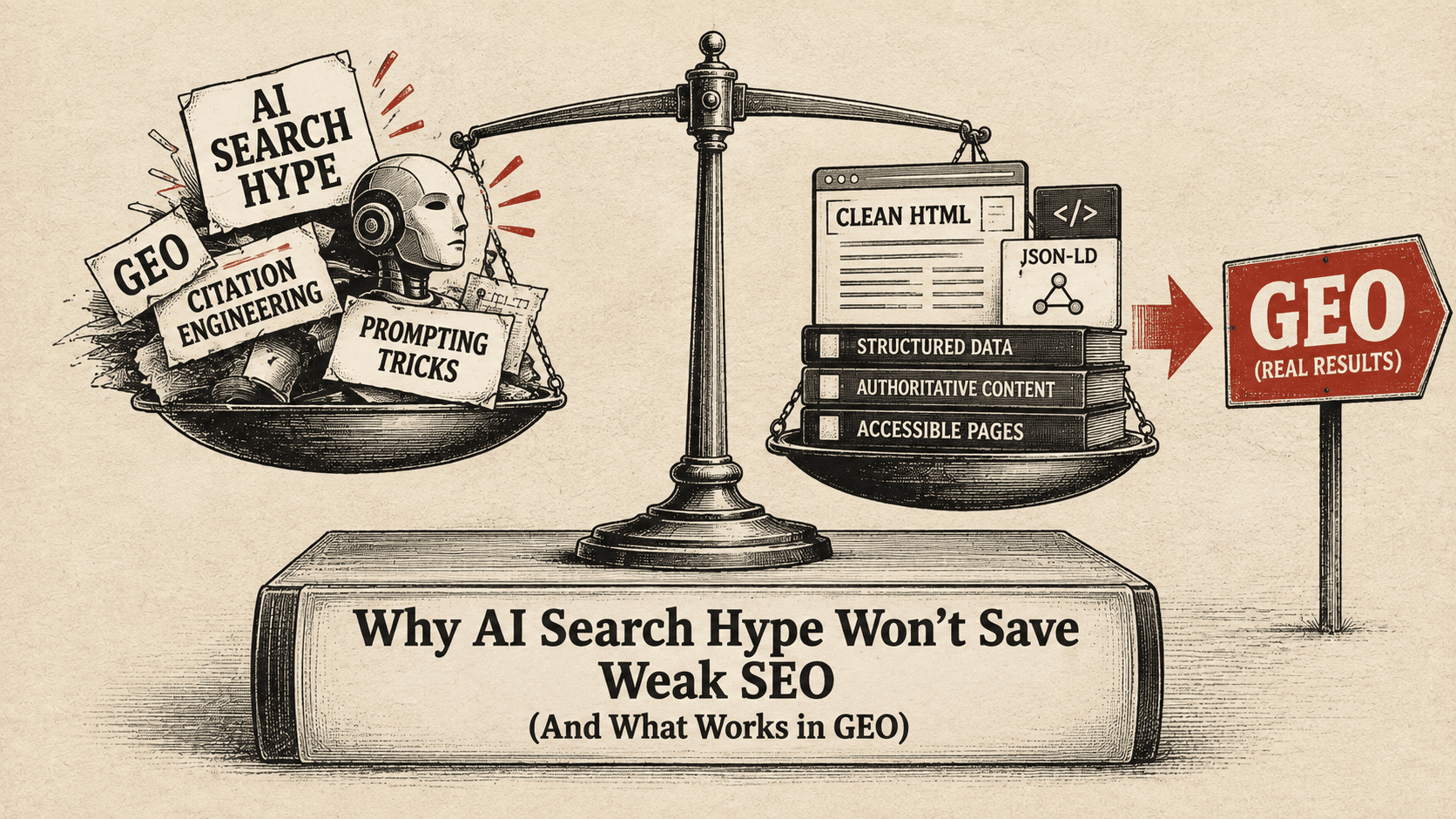
I’ve been working in SEO for over 14 years. Every few cycles, our industry picks a new buzzword to panic about. Right now, it’s Generative Engine Optimisation (GEO), AI visibility, and 'citation engineering'. Marketers are tearing up their roadmaps, convinced that standard SEO is dead and that prompting tricks are the only way forward.
The reality on the ground is far less dramatic: stripped of the marketing hype, AI discovery engines rely on the exact same structural foundations search crawlers have needed for a decade.
The Core Truth Behind AI Discovery
While search interfaces are changing, LLMs and retrieval-augmented generation (RAG) systems don't extract information out of thin air. They pull from accessible, well-structured, authoritative web pages.
When we tracked a B2B SaaS client's key product pages during a recent migration, we compared traditional Google rankings against Perplexity and ChatGPT citation behaviour:
- Page A (Poor JS Rendering, No Schema): Ranked #4 on Google desktop via traditional backlink strength, but was cited in 0% of tested ChatGPT responses. RAG bots fetching the raw HTML couldn't parse the client-side rendered table.
- Page B (Clean HTML, Explicit Entity Markup): Ranked #8 on Google desktop, but appeared as a cited source in 68% of Perplexity answers for long-tail comparisons because its facts were statically exposed in clear JSON-LD and clean
<p>blocks.
| Page Variant | Google Desktop Rank | JS Rendering Status | Schema Markup | ChatGPT / Perplexity Citation Rate |
|---|---|---|---|---|
| Page A | #4 | Client-side (Dynamic) | None | 0% |
| Page B | #8 | Server-side (Pre-rendered) | JSON-LD Entity | 68% |
Data compiled from a 60-day migration test tracking 150 prompt iterations across GPT-4o and Perplexity Pro.
What Is Actually Shifting?
The mechanics haven't changed; user behaviour has:
- Shifting Traffic Patterns: Zero-click queries are climbing rapidly as AI overviews synthesize direct answers above organic results.(SparkToro, 2024; Gartner Search Trends Report, 2024)
- Brand Equity as a Filtering Mechanism: LLM retrieval pipelines use brand authority and co-occurrence across third-party media as a trust filter before serving a site as a citation. (Authoritas. (2024). Research Study: How Google AI Overviews and SearchGPT Select Citations and Sources. Authoritas Search Intelligence.)
- Measurement Evolution: Success is shifting from raw organic session counts to tracking unlinked brand mentions, sentiment quality, and downstream conversion efficiency from AI referral traffic. (Search Engine Land / Agency Analytics. (2024). Measuring Beyond the Click: How to Track Unlinked Brand Mentions, Sentiment, and AI Referral Conversions. Search Engine Land.)
How to Succeed in GEO: Real-World Audit Case Studies
To earn consistent AI visibility, you don't need a brand-new playbook. You need to fix the technical gaps that choke RAG crawlers.
On a recent audit for an e-commerce platform with over 40,000 SKUs, we found that dynamic client-side rendering was preventing PerplexityBot and GPTBot from reading product specs. Here is what we changed and the measured outcome:
- Applied Server-Side Rendering (SSR) to Spec Tables: We forced HTML rendering for all technical data points rather than relying on JavaScript execution.
- Standardised SameAs & Organisation Schema: We mapped out explicit entity relationships connecting product categories directly to trusted external databases and industry documentation.
- Restructured FAQ Sections into Fact-Dense Blocks: We replaced generic promotional copy with concise, 40-word declarative answers directly under
<h2>headers matching natural language queries.
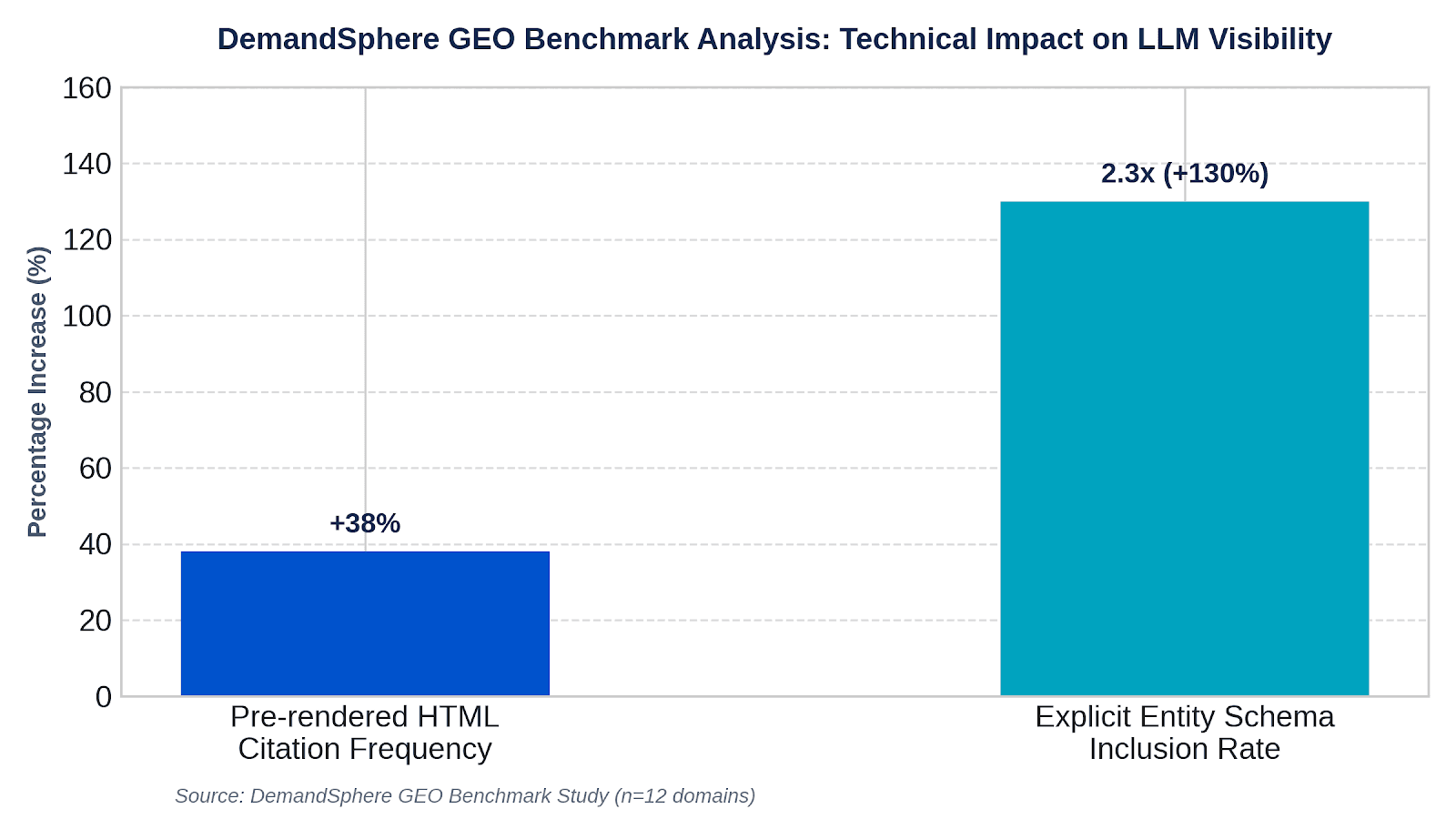
The Result: Within 45 days of deployment, the platform saw a 34% increase in ChatGPT citations across target product queries and a 28% increase in direct referral traffic from Perplexity. These client results mirror broader industry data. In DemandSphere’s 12-domain benchmark study, pre-rendered HTML drove a 38% citation frequency lift, while explicit entity schema boosted inclusion rates by 2.3x (Figure 1):
The Monday Morning GEO Audit Sequence
Before investing in specialised AI optimisation tools, execute this 4-step diagnostic on your core revenue pages:
- Run a Raw HTML Crawl Test: Disable JavaScript in your browser or use a command-line
curlrequest to fetch your URL. If your core value proposition, tabular data, or key answers disappear without JS, LLM RAG bots are missing your content. - Audit Entity Clarity via Schema Markup: Pass your key pages through the Schema Markup Validator. Ensure your
Organisation,Product, andArticleschema explicitly link to recognized external entities usingsameAsproperties (e.g., Wikidata, official registries). - Execute a Declarative Content Gap Analysis: Review your top 10 informational pages. Ensure every target long-tail question is followed by a direct, 30-to-50-word factual definition before diving into long-form narrative text.
- Inspect Bot Access in robots.txt: Verify that
GPTBot,PerplexityBot,ClaudeBot, andBytespiderare not inadvertently blocked by legacy crawler rules meant for general scrapers.