The Hardest Optimisation Is Doing Nothing
Most bad account decisions come from touching campaigns when the right move was to wait: here is a four-state framework for knowing which side of that line you are on.

 Ana Kostic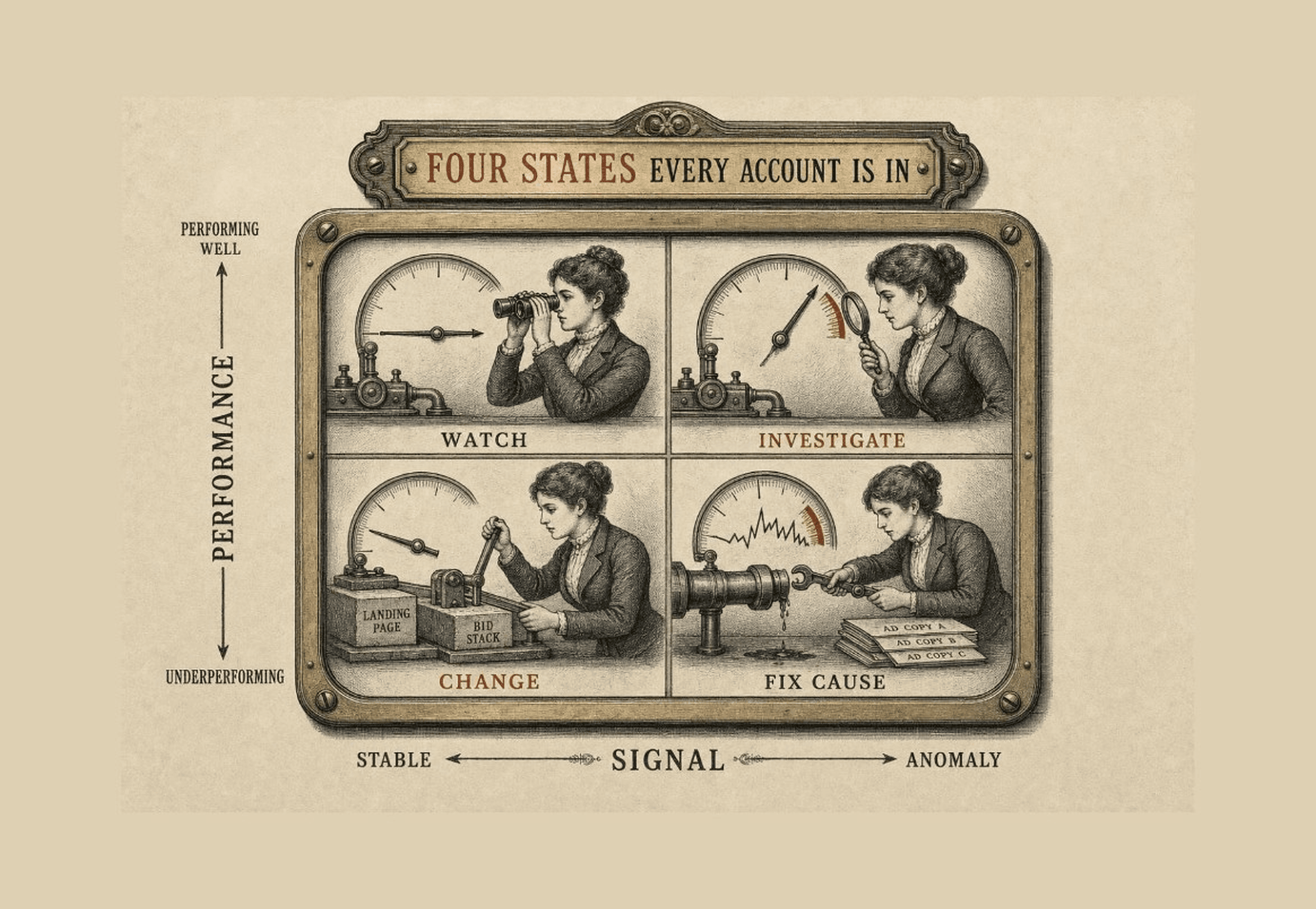
There is a feeling every campaign manager knows: something is not going the way you expected, and you have to decide whether to touch the account or wait.
Almost always, the impulse wins. You adjust a bid, pause an ad, split an ad group, launch a test. Doing something feels productive. Waiting feels like you are not doing your job.
Some of the worst decisions in paid media come from exactly that place.
Optimising is not the same as touching
Optimising means making a decision backed by enough data that moves the account in a clear direction.
Touching means making a change because you have not done anything in three days and you feel like you should.
Platforms cannot tell the difference. To the algorithm, both look the same. Every unnecessary reset costs time and budget.
Spend ticks up one day more than usual. You look for an explanation. "I added those keywords last week. That must be it." You pause the keywords. Spend comes down. You feel clever.
Maybe spend was going to come down anyway. Systems fluctuate. What you have done is cement a false belief: linking a random swing to something you did.
This has a name: the narrative fallacy.
Those false certainties stack. You end up convinced certain actions work when they never had a measurable effect. Future decisions are built on lessons that were never true.
Am I optimising, or am I touching because waiting feels uncomfortable?
You have to have data before you make a decision
You launch a new target CPA (tCPA) bidding strategy. After two days, CPA is double what you expected. What do you do?
If your answer is "change the bid" or "switch the audience," you are deciding on data that may not mean anything yet.
In Google Ads, many campaigns need at least two to three weeks to stabilise, and enough conversion volume that a week of data is not pure guesswork. Before that, you are often looking at normal learning fluctuation, do not treat it as verdict on the setup.
Yes, sometimes results are bad at the end of the learning phase and you need to change something. At least then you have data for an informed call.
If a lead gen client averages five leads a day, there will be days with zero leads and whole weeks with four leads. The client calls, panicked. But over six or twelve months, those empty weeks often fall within what is normal for the volume and budget.
Nobody remembers the zero-lead week from three months ago. They remember this week. And they react as if it were an emergency when it may be a routine fluctuation.

Smart Bidding is not set-and-forget, and it is not touch-it-daily
Automated bidding needs stability.
Every time you change a CPA target, daily budget, or bid strategy, the system recalibrates. Do that every few days and the algorithm never finishes learning what actually works.
That does not mean you cannot change anything. It means changes should be justified by data, not anxiety.
A useful rule: define upfront the thresholds that justifies a change. For example: "if there are zero conversions after 200 clicks, I will review the setup." The decision then depends on a criterion you set with a clear head, not on how the dashboard feels at 4pm on a Thursday.
When you do change something, change one thing. Not three. Not five. One. Then wait to see whether that change produces a real effect.
When you test one variable and measure with patience, you run into something uncomfortable: most changes have no measurable effect. They do not improve or worsen anything.
When you change five things at once and something improves, you convince yourself everything mattered. In reality it was probably one of them. Or none.
Your data has to be trustworthy before you act on it
Before you obsess over performance, make sure what you are looking at is real.
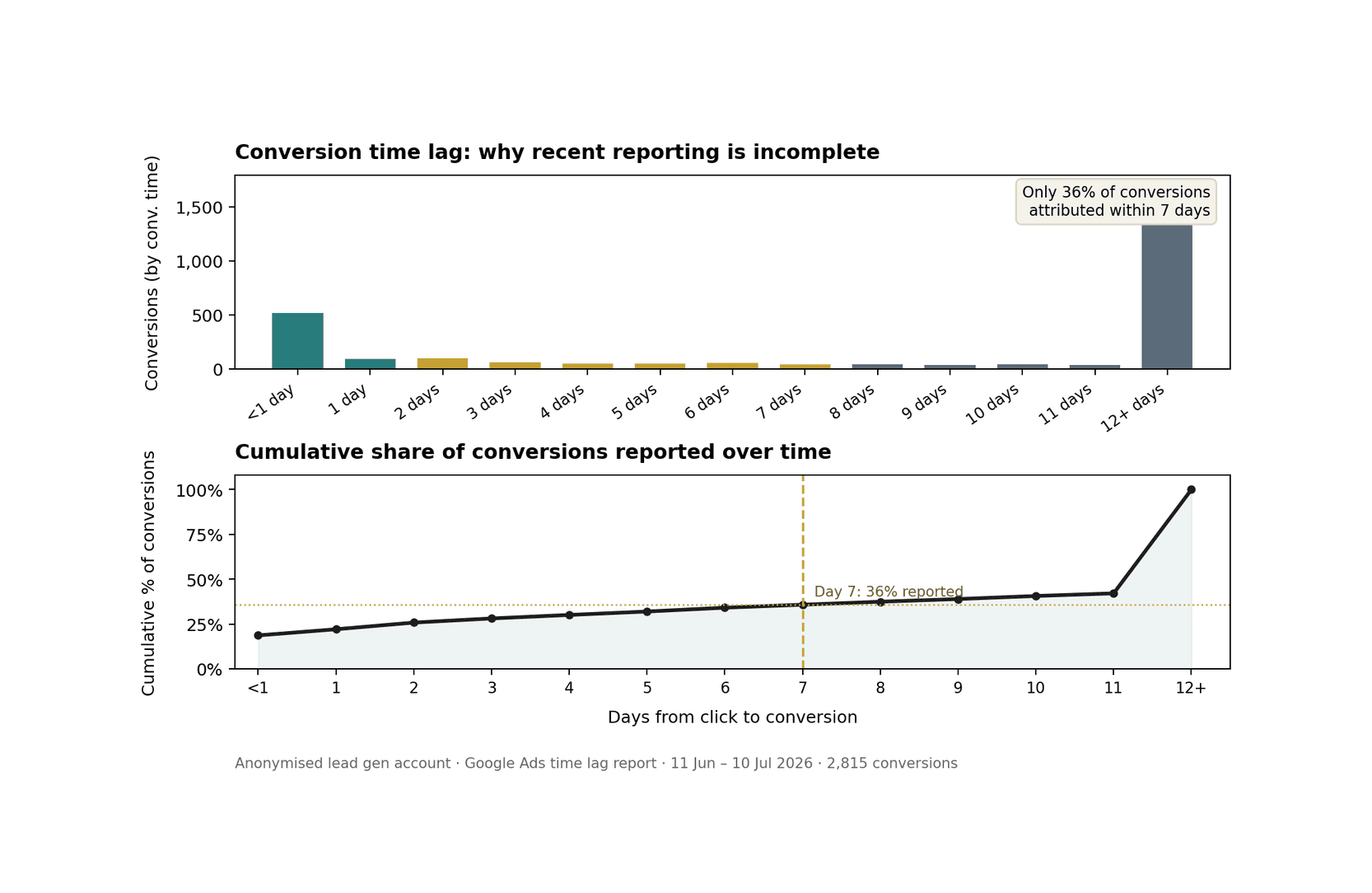
I have lost count of how many strategy shifts were built on conversion data that was misconfigured: a pixel double-counting, a primary conversion action that included events that were not business goals, a CRM import lagging by 7 days.
If your data is not reliable, discipline does not help. You are making logical decisions on incorrect information.
Before you touch anything structural, check what you are measuring. Then decide whether the numbers justify a change.
A routine protects you from yourself
If you review accounts every day without a framework, you will make changes that should not happen. You are watching numbers move and your brain will find patterns where there are none.
Define moments for each type of review:
Daily: check that nothing is broken (budgets exhausted, accidental pauses, disapprovals). Look only. Do not touch structure.
Weekly: review performance on a full week of data. Optimise here if the data supports it.
Bi-Weekly / Monthly: review trends, compare to prior periods, adjust strategy if needed.
The four states every account is in
Every account, at any moment, is in one of four situations:
- Performing well and stable. Do not touch. Your job is to watch, not intervene. The client pays you to know when to act, not to look busy.
- Performing well, but something anomalous is happening. Investigate what caused the lift and make it permanent (if possible).
- Underperforming, and something anomalous is happening. Find the cause of the anomaly and remove it. Do not rewrite ad copy when something structural is skewing results.
- Underperforming, but stable. Here you need a real change: bid strategy, landing page, campaign structure. Something that deliberately moves the account in another direction.
Knowing which of the four you are in is most of the job. The rest is having the discipline to act accordingly.
In summary
- Most optimisation work is deciding when not to change anything.
- Ups and downs are often normal fluctuation, not signal.
- Wait for enough data and trustworthy measurement before structural changes.
- Test one thing at a time and accept that many changes do nothing measurable.
- Define objective thresholds for when to act.
- Use daily / weekly / monthly reviews to separate looking from touching.
The hard part is not knowing which button to press. It is knowing when not to press any of them.
Ana Kostic
It sounds simple. If you have managed campaigns for years, you know the hard part is not knowing which button to press. It is knowing when not to press any of them.