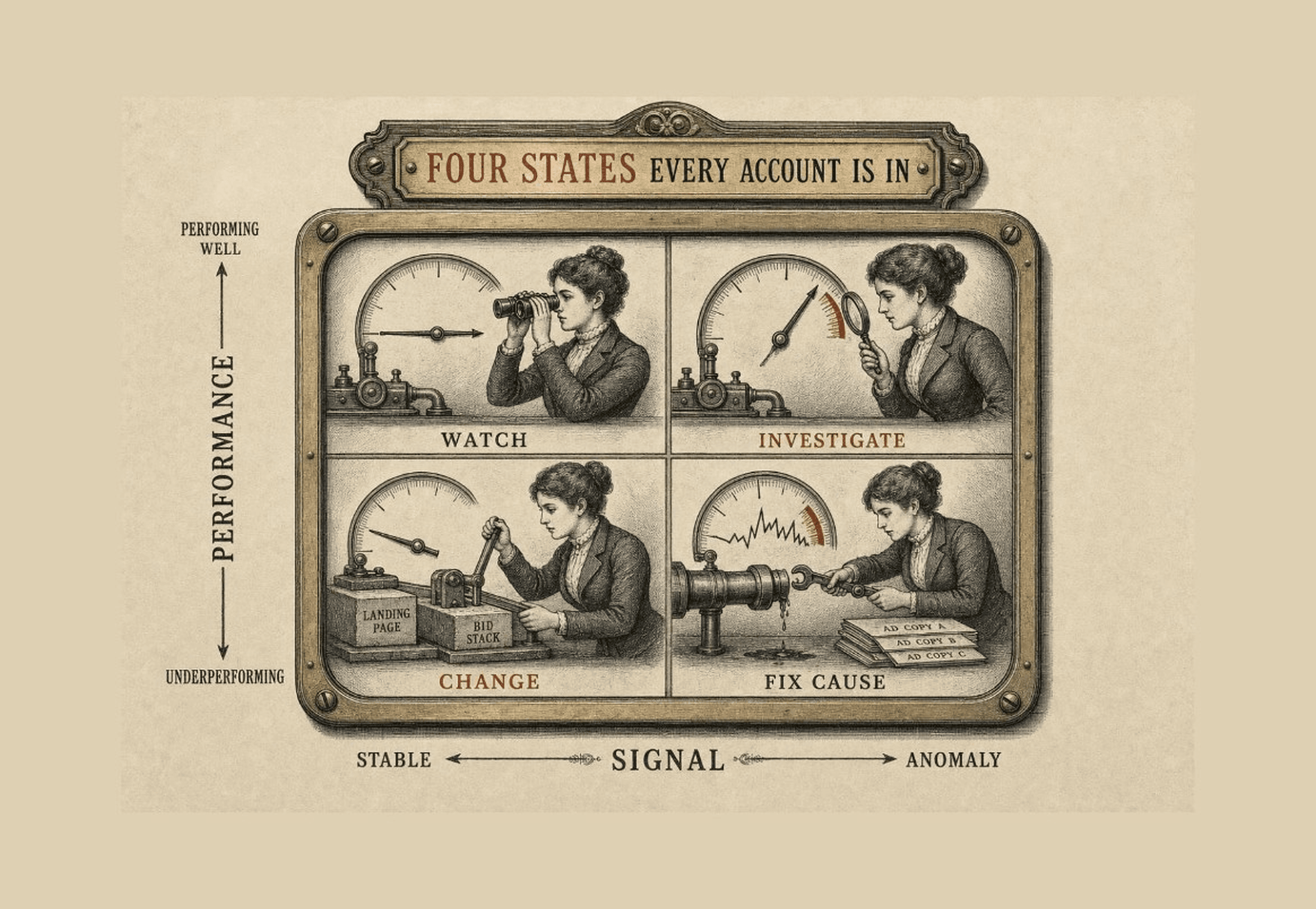
Paid search will tell you your positioning is wrong before anything else does
A UK challenger brand cut CPA by 76% by rewriting copy to buyer intent rather than changing bids. Here is how to use search queries to fix positioning before the brand tracker even reports back.


A positioning statement gets signed off in a room where being wrong carries no cost that quarter. The brand tracker reports back in six months. The qualitative work lands in three. A search campaign reports back on Thursday.
Search campaigns produce two outputs. One is the leads, revenue and pipeline that everyone reports on. The other is a running record of which claims strangers accept and which they scroll past, priced by the auction, with volumes attached. Most businesses read the first and throw the second away.
I have spent over 10 years running paid media alongside multiple channels in agencies and in house, across B2B and B2C, with budgets running from £50 a month up to £10 million a year. The pattern holds at both ends of that range. The account gets judged on efficiency, the strategy gets set somewhere else, and nobody carries the information between the two rooms.
The proof is in the pudding > here are some results I’ve achieved
| Result | Context | Strategic Lever |
|---|---|---|
| **76% reduction in CPA YoY** | Challenger UK brand | Changes to the proposition in the ad copy and on the landing pages |
| **30x ROAS** | Global B2B account | Rebuilt campaigns around customer journey mapping (added six figures to pipeline in 30 days) |
| **Six figure annual saving** | Travel business | Change in account and bidding strategy |
Three things sit behind everything below.
Paid search puts a price on your claims. The auction charges you more when your proposition is a weak match for what someone is looking for, so cost per click and click through rate carry information about your positioning before they carry information about your media buying.
Search queries are the market describing its own problem in its own words. Positioning documents are usually written in the language of the business. Where those two vocabularies separate, you are paying to close the distance on every single click.
The reason this intelligence goes unused is organisational. Paid media reports into performance, performance is measured on efficiency, and efficiency reporting has no field for what the channel learned.
What the auction is charging you for
At a UK challenger brand I worked with, we were bidding on wider/broader level terms with ad copy that described the product to TOFU/MOFU audiences. Cost per acquisition had risen every year for three years. The change that moved it was writing to the intent of the decision the prospective customer was making, which involved affordability, requirements, and whether the product was the right fit for them.
Cost per acquisition fell 76% year on year. The bidding barely changed.
That was a positioning finding that arrived through a media channel. It applied to the physical brochures, the scripts the business used and the call centre call handling long before it applied to the next set of ad groups.
Search queries are the market describing its own problem in its own words. Where those two vocabularies separate, you are paying to close the distance on every single click.
Azeem Ahmad
Search queries are the only unprompted research you get for free
Every other research method asks a question first. Focus groups, surveys, customer interviews, all of them start by putting a topic in front of someone. Search terms are what people typed when nobody was watching and they wanted something, with volume attached and intent already sorted.
In B2B this catches teams out in a specific way. You convince the senior buyer, then Legal has to accept the terms and Finance has to accept the cost. Those people search too. They look for data residency, contract terms, security certifications, total cost of ownership, and comparisons against whatever you are replacing.
If your search programme only covers the buyer, your proposition never reaches the two people with the power to stop the deal after the buyer has said yes.
Why the channel keeps losing the strategy argument
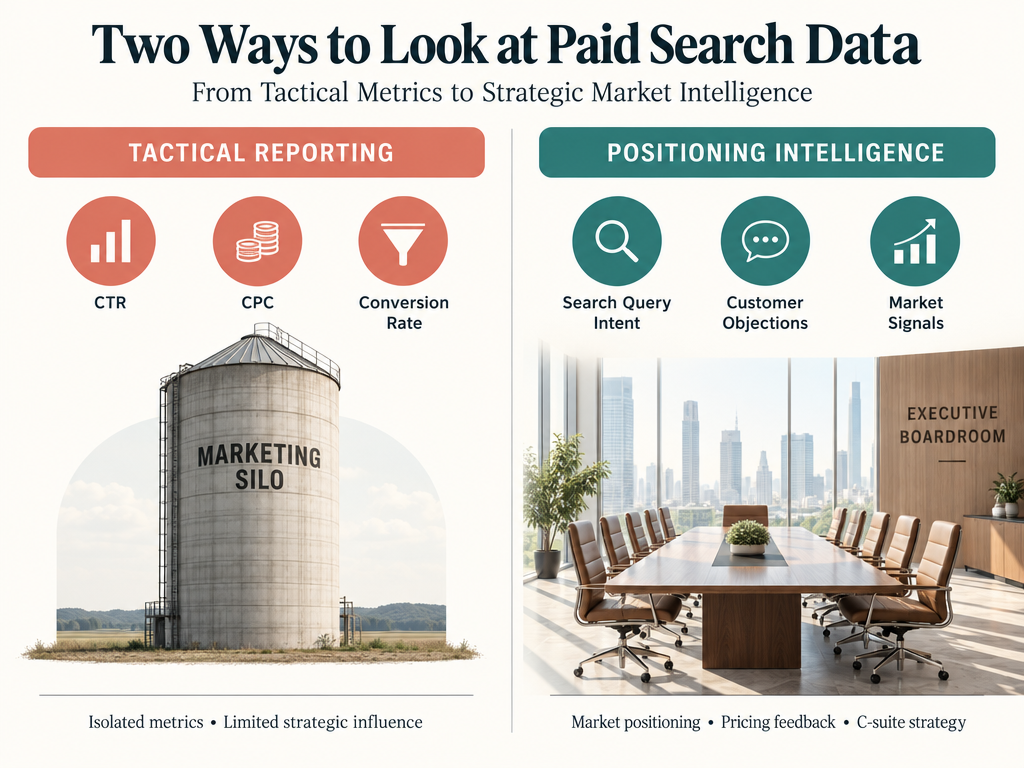
I have said in most of my conference talks that the boardroom does not care about click through rate. The boardroom also does not care about impression share, quality score, or how well structured your account is.
A paid media report containing only efficiency metrics gets read as an efficiency function, and an efficiency function has budget decisions made about it by other people.
The boardroom does not care about click through rate. A paid media report containing only efficiency metrics gets read as an efficiency function, and an efficiency function has budget decisions made about it by other people.
Azeem Ahmad
The teams I have watched change this did one thing. They added a section to the monthly report covering what the channel learned about demand, language and objections, written in plain business terms, with the media numbers still in the appendix where they belong.

The time I got it wrong
Early on in my career, I worked with a B2C retailer who had a seasonal product/offering. At the time, I arbitrarily decided budget splits without ever thinking of the customer, or time of year properly. I just found a clean, even split and went with it. For a while, we held a large amount of the market in terms of impression share, but the sales just weren’t coming in, and for the life of me, I couldn’t figure out why. I was spinning several plates at once, and only when I decided to put them all down and critically investigate the account, I figured out quite quickly that our competitors were pulling back when the weather didn’t favour product sales, whereas we were inadvertently pushing forward.
Very quickly I learned about the external factors at play when setting and managing budgets and strategy, and safe to say, a similar mistake hasn’t been made since.
The actions you can take to continue winning in paid media
Short term, the next 30 days
- Read your search term report as customer research. Pull 90 days of search terms, strip out the brand queries, and group what remains by the problem the person is describing. Look for the words that appear repeatedly in that list and appear nowhere in your positioning document (If you don’t have a positioning document, you should get one, fast). Those gaps are what you are currently paying a premium to cover.
- Run your positioning statement through the auction. Take the claim your business leads with and write it as an ad copy. Run it against whatever is live now. A fortnight and a modest budget will tell you whether that claim earns attention from someone with no prior relationship with you. Very few businesses have ever put their core claim in front of a stranger holding a credit card.
- Send the query language to everyone else who writes. The words that win in search belong in the sales deck, the website copy, the email programme and the brief for the next brand campaign. This costs nothing and takes about an hour.
Medium term, one to two quarters
- Change what paid media reports upward. Add a demand and language section to the monthly reporting, positioned ahead of the efficiency numbers. Name the objections showing up in the data, the terms growing quarter on quarter, and the claims that are losing ground to competitors. Keep it to one page and write it for someone who has never opened Google Ads.Some of the best reports I’ve had my teams make have been duplicated, one report for efficiency metrics, and one for the language for the boardroom.
- Test propositions before you commit to them. Pricing framing, guarantees, delivery promises, trial length, contract terms. Every one of these can be tested in ad copy and on landing pages for the cost of say a fortnight of media, months before they get committed to a brand campaign or a rebrand that costs a hundred times more to reverse.
- Build the secondary decision maker into the account structure. In B2B that means campaigns for Legal, Finance and Procurement running alongside the primary buyer, with their own language, their own objections and their own landing pages. In B2C the equivalent is whoever else is in the room when the purchase gets discussed.
- Run an incrementality test on your largest campaign. Geographic splits, or a scaled back period on brand terms. You need a defensible answer to how much of that return is demand you created and how much is demand you collected, because someone will eventually ask and the attribution model will not settle it.
Long term, the next 12 months
- Put paid media into planning before the budgets are set. The channel holds the most recent read on what the market wants and what it costs to reach them. That belongs in the September planning conversation, well before the January execution meeting where the numbers have already been decided.
- Build marketing mix modelling alongside your attribution. Attribution will never resolve cleanly, and the privacy changes of the last few years keep moving it further out of reach. Modelling at the level of the whole budget gives you a view of what paid media contributes to the business that a finance director will accept.
- Prepare for agent assisted buying. Agents filter on certainty. Vague delivery terms, unclear returns policies, aggressive bot detection and slow pages get filtered out before a human ever sees the option. Auditing those rules and writing unambiguous policy copy is now a paid media concern, because agents arrive through the same surfaces you are already bidding on.
Azeem's take
I have watched capable paid media managers sit on findings that would have changed a positioning decision, because raising it in a meeting about cost per acquisition looks like deflection from a number they missed.
The intelligence gets produced whether anyone reads it or not. What decides the outcome is whether someone senior treats the monthly performance review as a legitimate place to ask what the business is claiming and whether the market agrees with it.
That is a leadership decision, and it costs nothing to make.
Try this
Take the claim your business leads with. Write it as three ad variants. Run it for a fortnight against whatever is live now, and see whether a stranger agrees with your marketing team.
Send me what happened at hello@iamazeemdigital.com. I am particularly interested in the cases where the claim held up. Happy strategising!