Google November 2026 core update: rollout may take up to 2 weeks
Google began rolling out the November 2026 core update on 10 November, globally, and says it may take up to 2 weeks. Google advises waiting at least a full week after it ends before analysing Search Console data.


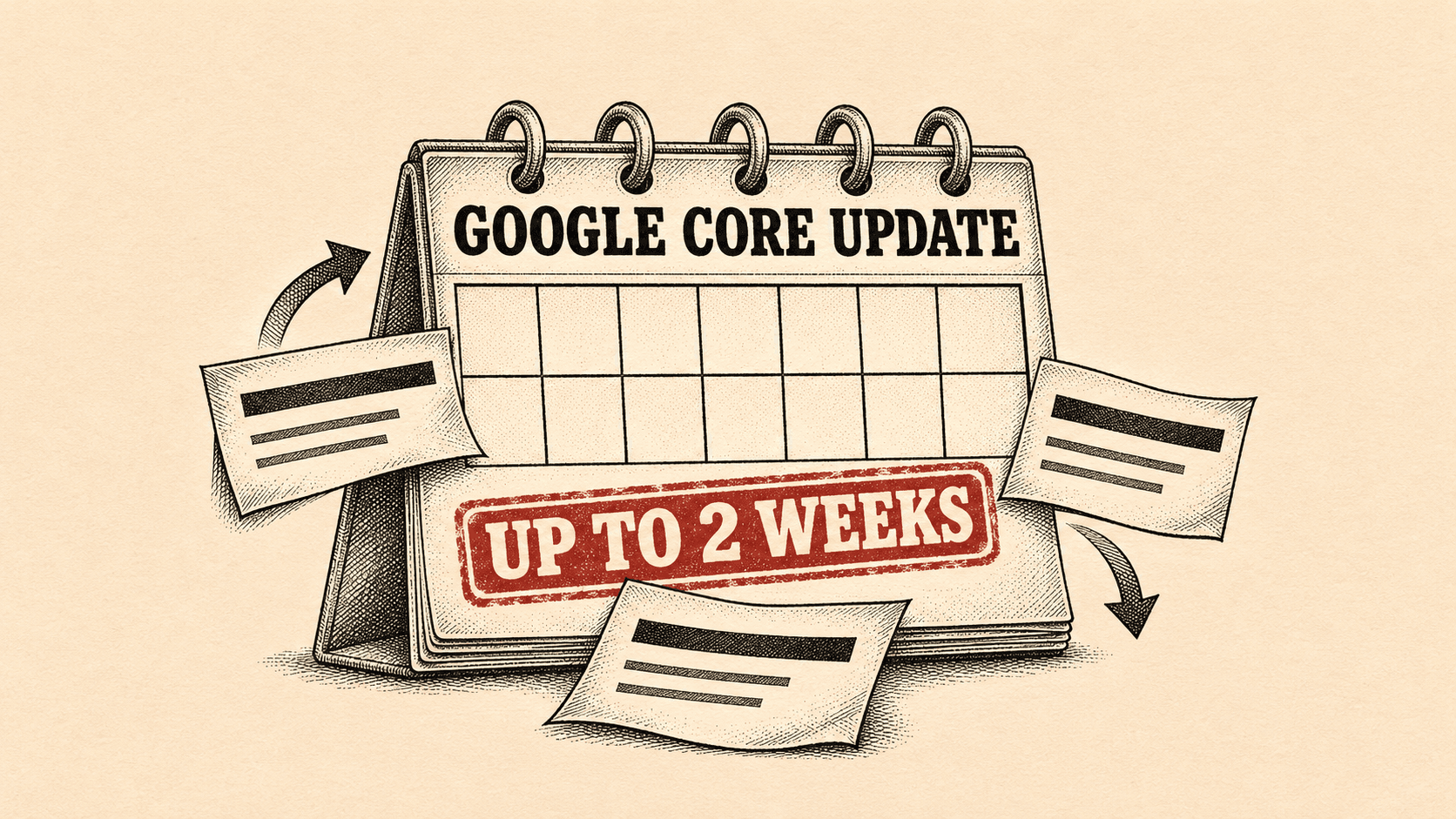
Google released the November 2026 core update on 10 November 2026, applying globally and to all languages, according to the Google Search Status Dashboard. The rollout may take up to 2 weeks, so wait for the dashboard to log the end date, then at least a further full week, before comparing performance with the week before 10 November.
What changed
Live now, rolling out. The dashboard lists the update as an incident affecting Ranking. It began at 10:06 on 10 November 2026 (all times on the dashboard are US/Pacific). Google Search Status Dashboard says the update "applies globally and to all languages. The rollout may take up to 2 weeks to complete."
What the entry does not say. There is no description of what the update targets or changes. The dashboard entry records the release, the scope and the rollout window, and nothing else.
How Google describes core updates in general. Google's core updates documentation says it makes significant, broad changes to its search algorithms and systems several times a year, and calls these core updates. It says they "don't target specific sites or individual web pages". The same page says "In general, most sites don't need to worry about core updates and may not even realize one has happened." It also says Google makes smaller core updates continually, and that these are not announced because they are not widely noticeable.
Google's guidance on the status dashboard says that when a ranking update is noted there, readers should follow the link, when one is provided, to learn more, and adds: "Often, there's no action needed."
What this means for specialists
For most readers the question is when to measure. Sites that do see movement in this window have no explanation from the dashboard entry to go on.
Google's documentation also notes that positions in Search results are not static, and that constant change can cause both gains and drops in organic Search traffic.
Google's advice on timing is specific. Its documentation says to confirm the update has finished by checking the Search Status Dashboard and noting the start and end dates. It then recommends waiting at least a full week after the update completes before analysing a site in Search Console, and comparing that week with the week before the update started rolling out.
Google also sets out how to read a drop in position. A small drop, its example being position 2 to 4, needs no drastic action, and Google recommends avoiding changes to content that is already performing well. A large drop, its example being position 4 to 29, calls for a deeper assessment. Google says to analyse different search types separately, so that a fall in Web Search, Google Images, Video mode or the News tab is not blended into one number.
Google's documentation also warns against quick fixes, such as removing a page element because you heard it was bad for SEO, and calls deleting content a last resort.
For a sustained, large drop across a site as a whole, Google says to read through its self-assessment to check whether the site overall, not just individual pages, delivers helpful, reliable, people-first content. It says to evaluate the pages most impacted, because other pages on the web may be doing a better job of helping the searcher. It also suggests asking people you trust who are unaffiliated with the site to do the assessment.
On recovery, Google says some improvements can take effect in a few days, but it could take several months for its systems to learn and confirm that the site as a whole is producing helpful, reliable, people-first content in the long term. If there is no effect after a few months, that could mean waiting until the next core update. Smaller core updates, which are not announced, can also lift positions. Google adds that there is no guarantee that changes will produce a noticeable impact.
What to do this week
- Record the rollout dates. Note the 10 November 2026 start date and check the Search Status Dashboard for the confirmed end date.
- Pull your baseline. In Search Console, review your top pages and queries for the week before 10 November, which Google's guidance uses as the comparison point.
- Subscribe to the dashboard's RSS feed. Google says you can use it to be notified about issues and updates.
- Plan the comparison. Once the update has finished, wait at least a full week before analysing Search Console, then compare performance with the baseline from step 2.
- Split your search types. Set up your review so Web Search, Google Images, Video mode and the News tab are looked at separately.
- Sort movements by size. For each top page and query, note whether the drop is small (Google's example: position 2 to 4) or large (4 to 29). Leave content that is already performing well alone, and keep the self-assessment for sustained, large drops across the site as a whole.
What is not yet known
- What the update changes. The dashboard entry gives no description. Google's core updates documentation offers standing guidance on core updates in general, not detail on this one.
- When the rollout will end. Google says only that it "may take up to 2 weeks", so the finish date is not fixed.
- Whether any markets or languages will see the effect later than others. The entry says the update applies globally and to all languages, and says nothing about timing by region.
- Which types of site, if any, are more exposed. Google's documentation says core updates do not target specific sites or pages, and the entry offers no further detail.
Sources & Further Reading
- Google Search Status Dashboard: Incident detailshttps://status.search.google.com/incidents/WLxcJyC6jMWMfryxsKMc
- Google for Developers: How to Use the Google Search Status Dashboard | Google Search Central | Supporthttps://developers.google.com/search/help/status-dashboard
- Google for Developers: Google Search's Core Updates | Google Search Central | Documentationhttps://developers.google.com/search/docs/appearance/core-updates