Gemini 4 Carbon comes to AI Mode for Google AI Ultra subscribers
Gemini 4 Carbon, which Google calls its strongest model, is rolling out in AI Mode in Search to Google AI Ultra subscribers. Anyone auditing AI Mode answers should record the account tier.


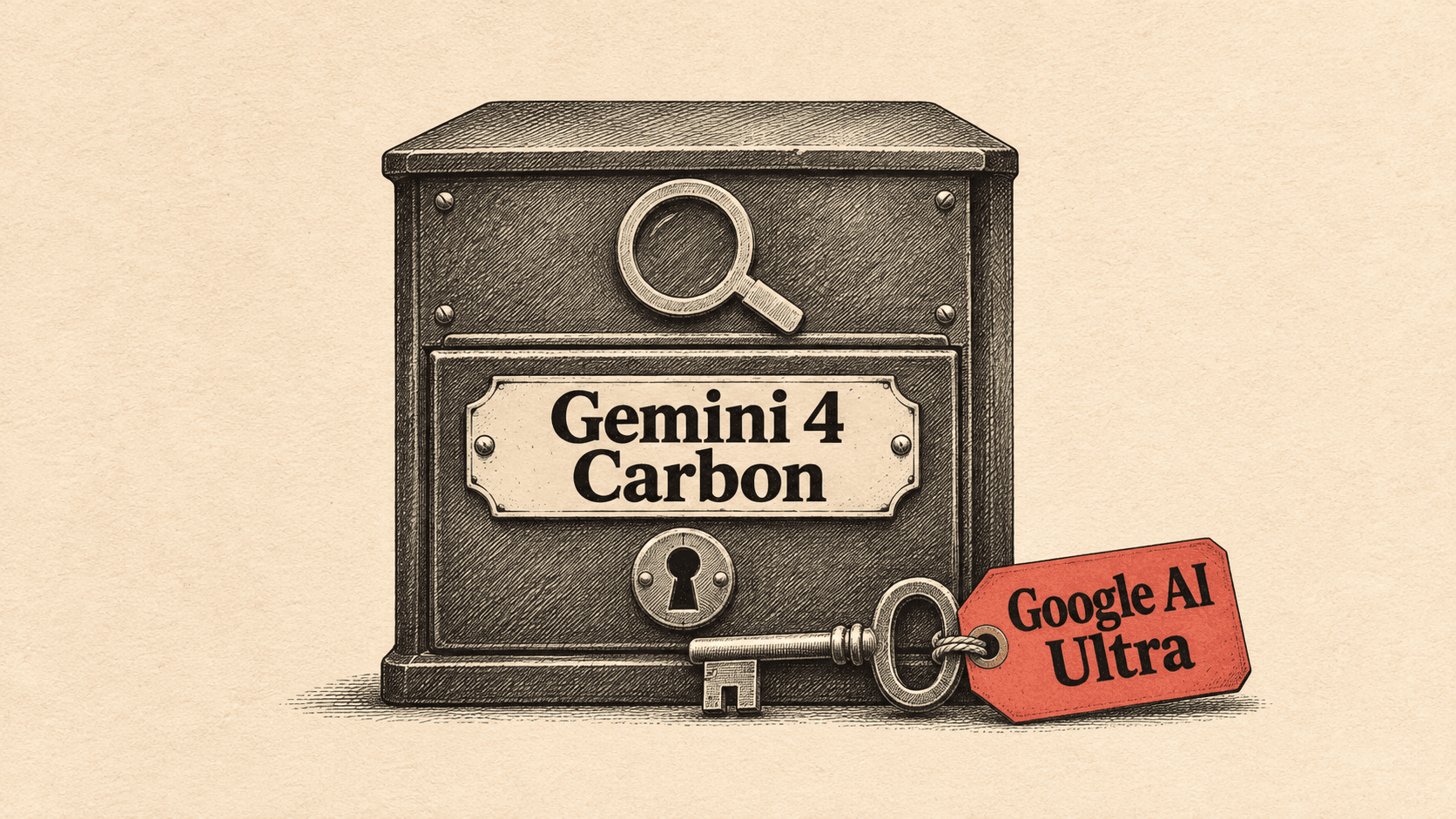
Google has put Gemini 4 Carbon into AI Mode in Search for Google AI Ultra subscribers. Anyone checking how AI Mode answers complex queries now has reason to record which account tier produced the answer. Google announced wider availability of Gemini 4 Carbon on 10 November 2026.
What changed
Rolling out now to Ultra subscribers. Google's announcement says Carbon is "rolling out to all Google AI Ultra subscribers in Google Antigravity, the Gemini app, and AI Mode in Search". The getting-started section is plainer: "Try Carbon starting today in the Gemini app and AI Mode in Search if you're a Google AI Ultra subscriber." The post gives no rollout timetable beyond that, so "starting today" and "rolling out" are both Google's wording.
Available through the API. Carbon is available in Google AI Studio and Gemini for business for all paying developers and enterprises. The introductory price, the same as Gemini 4 Argon, is $2 per million input tokens and $10 per million output tokens. A footnote says the introductory period expires on 30 November 2026, after which $4 per 1M input tokens and $20 per 1M output tokens apply. The footnote covers the Carbon model intended for public access only.
Preview. Google is previewing /swarm in Google Antigravity, which it describes as turning a single prompt into a coordinated team of agents.
By application. Cybersecurity defenders can apply to the Fairwind Program for Carbon for cyber on a rolling basis. Scientists can apply for Google Antigravity access to Argon and Carbon, onboarded on a rolling basis and subject to eligibility, capacity and selection.
How Google positions it. Google calls Carbon "our strongest model". It also says Argon "remains the ideal choice for the majority of software engineering and knowledge work", and that Carbon uses more tokens than Argon to reason deeply and run extended verification loops. Google says Carbon ranks #1 on CursorBench 4.0, Perplexity's WANDR and Zapier's AutomationBench at more than 2X lower cost per task than the next best external model. The announcement does not establish how those benchmark results translate to AI Mode or advertising work.
A related launch, five days earlier. On 5 November 2026 Google made Gemini Omni 1.2 Flash generally available across the Gemini API and Gemini for business. It supports native video up to 15 seconds (up from 10 with Omni 1.1), with duration settable in one-second increments from 3 to 15 seconds. Google says the price is 30% lower than Omni 1.1, at $0.07 per second for 720p video. Outputs carry a SynthID watermark. The Gemini app gets 15-second videos as a rollout to Google AI Ultra subscribers. The same post lists Google Ads under "scale video campaigns" without saying what is available there.
What this means for specialists
The immediate consequence is for anyone who tracks AI Mode. Neither source describes what Carbon does differently inside AI Mode, so any difference in answers is something to test, not something Google has stated. What the announcement does establish is that Carbon access in AI Mode is tied to the Google AI Ultra tier. That could affect comparisons between account tiers, so record the tier and test. A screenshot without the tier attached is weaker evidence.
That matters for client reporting. If a client says AI Mode does not mention them while you see them cited, the account tier is one thing worth recording and checking first. Your own account could also differ from the one a typical searcher uses, which is another reason to note it.
On the API side, the price change is the planning item. Carbon's introductory pricing ends on 30 November 2026, after which the public-access model costs $4 per million input tokens and $20 per million output tokens. Google also says Carbon spends more tokens per task. A workload using the public-access Carbon model and priced on the introductory rates will cost more per token afterwards, and it may use more tokens than it would on Argon. Google's cost-per-task claims come from third-party benchmarks it cites, so test them on your own tasks before relying on them.
The Omni 1.2 Flash pricing is simple enough to model: $0.07 per second at 720p means a 15-second clip is a known unit cost. Google's post says you can draft at 360p or 720p and upscale to 1080p or 4K, but it gives no price for 360p drafting or for upscaling to 1080p or 4K.
What to do this week
- Open your AI Mode test log and add a column for account tier (Google AI Ultra or not), with the date. Start it from 10 November 2026.
- Re-run your most complex AI Mode queries from one Ultra account and one non-Ultra account, if you have both, and save the answers side by side.
- Tell anyone who reports on AI Mode visibility to note the account tier beside each result, so results from different tiers are not read as one series without that note.
- If you call Gemini through the API in Google AI Studio or Gemini for business, check which model each workload uses. For workloads using the public-access Carbon model, work out the cost at $4 per million input tokens and $20 per million output tokens, the rates that apply after 30 November 2026.
- Before moving anything from Argon to Carbon, compare tokens used per task on a sample of your own work, since Google says Carbon uses more than Argon.
- If you plan to produce video with Omni 1.2 Flash, price one 15-second clip at $0.07 per second for 720p and check that the SynthID watermark on outputs fits your clients' requirements.
What we do not know yet
- What Carbon changes in AI Mode. The announcement says only that it is available there for Google AI Ultra subscribers.
- Whether Carbon is the default for Ultra accounts in AI Mode or something users choose.
- Which markets and languages the AI Mode rollout covers. The post does not say.
- When the rollout reaches all Ultra subscribers. Google uses both "starting today" and "rolling out" and gives no date.
- Whether or when Carbon reaches AI Mode for accounts outside Google AI Ultra.
- What the API price will be after 30 November 2026 for any use beyond the footnote's public-access Carbon model.
- What the Omni 1.2 Flash line about scaling video campaigns in Google Ads covers, and when. The post gives no detail.
- When the Gemini app's 15-second video generation reaches all Google AI Ultra subscribers.
Sources & Further Reading
- blog.google: Gemini 4 Carbon is now availablehttps://blog.google/innovation-and-ai/models-and-research/gemini-models/gemini-4-carbon-now-available/
- blog.google: Gemini Omni 1.2 Flash: 15-second video and lower pricinghttps://blog.google/innovation-and-ai/technology/developers-tools/introducing-gemini-omni-1-2-flash/