ChatGPT Ads swaps Max Bid for Target CPA from 9 November
ChatGPT Ads moves to Target CPA and Target CPC from 9 November and retires Max Bid and Max CPC on 1 January 2027. Bid caps become average-cost goals, so check your conversion data first.


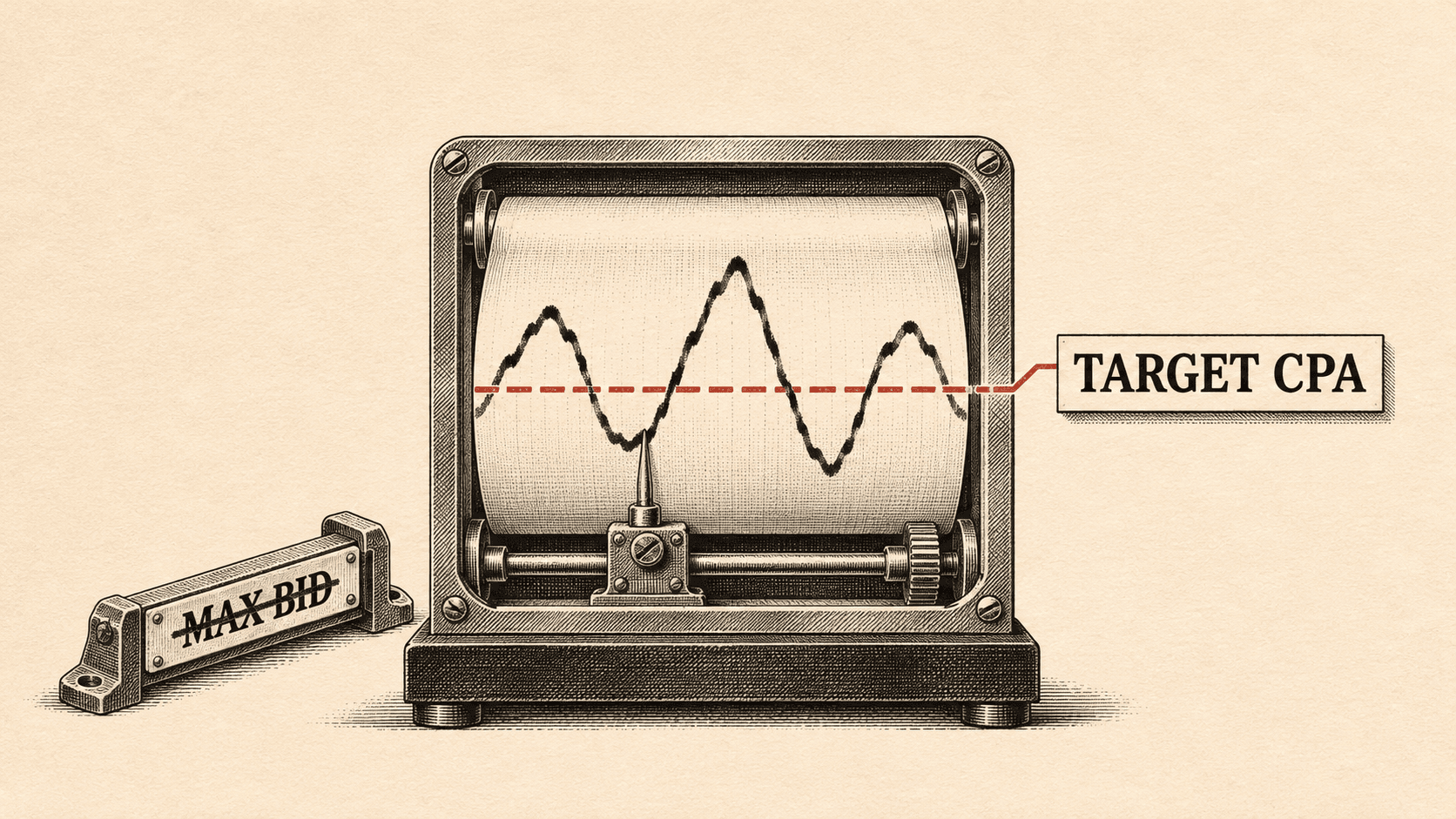
If you run ChatGPT Ads campaigns with a bid ceiling, the ceiling is going. OpenAI's Help Center guidance says that from Monday 9 November 2026, Target CPA replaces Max Bid for new conversion campaigns and Target CPC is available for new click campaigns. Max Bid and Max CPC retire for existing campaigns on 1 January 2027. The replacements are average-cost goals, and delivery leans on the quality of your conversion data.
What changed
Starting Monday 9 November 2026
- Target CPA replaces Max Bid for advertisers creating new conversion campaigns who want a specific cost per conversion. OpenAI describes it as the average amount you would like to pay for a conversion, such as a purchase or lead.
- Target CPC is available for new click campaigns. OpenAI says the system can bid above or below your target in individual auctions.
- OpenAI tells advertisers to begin moving existing campaigns in Ads Manager from 9 November 2026.
Intelligent bidding, formerly Maximize Results (Autobid), stays as the option for pursuing results within your budget without a target. The sources describe no change to it.
Retiring on 1 January 2027
Max Bid and Max CPC retire for existing campaigns. OpenAI calls them legacy bid controls: Max Bid sets an auction-bid ceiling and Max CPC sets a maximum click bid.
API partners
OpenAI says it is adding dedicated Target CPA and Target CPC fields, so partners can create campaigns with target bidding or switch existing campaigns to it. The timeline it gives:
- Before 18 November 2026: the Max Bid and Max CPC fields keep their existing behaviour, and partners can adopt the new fields once they are available.
- From 18 November: OpenAI recommends the new fields. The legacy fields stay supported through 31 December, but using them to create a campaign or change an existing ad group's bid type selects Target CPA or Target CPC, and submitted values represent average-cost targets, not maximum bids.
- From 1 January 2027: the legacy fields are deprecated, and partners should update integrations before then.
How pricing works
OpenAI says auctions determine which eligible ads are shown and the final winning auction bid sets the price you pay, across all bidding strategies, including existing Max Bid and Max CPC campaigns. A Target CPA or Target CPC is, in OpenAI's words, an average-cost goal and "not a fixed price per conversion or click". Its example: a $50 Target CPA means some conversions cost more and others less. OpenAI also says bidding goal and billing event are separate settings, so a campaign can optimise for conversions while being charged on clicks or impressions.
What this means for specialists
A Max Bid campaign had a hard ceiling on individual auction bids. A target does not: OpenAI says the system manages individual bids and may bid above or below the target. A campaign that relied on the ceiling for cost control will need watching against actual average cost. That is an implication of how OpenAI describes the two controls, not something it states in those words.
Start from recent actual CPA for the same conversion event, or actual CPC for a click campaign, over a consistent period that allows for conversion-reporting delay. OpenAI's example: $400 in spend and 10 attributed purchases gives an actual CPA of $40, and a $20 target does not mean the system can deliver purchases at half that cost. It warns that a target below recent performance may restrict delivery.
Then there is the data. OpenAI says weak or missing conversion signals can reduce delivery and leave budget unspent, and that "Setup alone does not establish that usable conversion signals are being received." Event Quality Score (EQS) describes how useful received event information is for measurement, but OpenAI says a high score does not establish that there are enough signals to support scale.
One constraint comes from the Conversion-optimized Campaigns article: the objective and billing option cannot be changed in place after creation, and nor can the conversion event. Moving from click billing to impression billing means cloning the campaign and selecting Impressions; for other changes, and for a different event, create a new campaign. Whether a Max Bid campaign moves to Target CPA in place or by rebuild in Ads Manager is not spelled out beyond OpenAI's instruction to follow the supported transition steps shown for your campaign. For API partners, the documented operation from 18 November is the legacy-field behaviour described above.

What to do this week
- In Ads Manager, open Conversions > Data Source and confirm real events are arriving at the data source linked to each conversion campaign.
- Run a Pixel test: open the three-dot menu on your Web Pixel, select Test, enter a page URL, then check the Test-labelled events in Event Stream. OpenAI says test labelling lasts up to 30 minutes.
- Open EQS and Diagnostics in Ads Manager and clear any warnings about missing matching information, delays or repeated events.
- Pull recent actual CPA or CPC over one consistent period and compare it with what the outcome is worth to the business before you set a target.
- List every campaign still on Max Bid or Max CPC, with its conversion event and billing option, so migration can be planned before 1 January 2027.
- If you send events through both the Pixel and the Conversions API, reuse the same event ID and Pixel ID on both sides. OpenAI says it keeps the first event received and ignores later duplicates.
- If you build against the API, find every use of the Max Bid and Max CPC fields before 18 November 2026 and plan the switch to the new target fields.
What we do not know yet
- Migration mechanics. For Ads Manager, the sources do not say whether existing campaigns convert automatically, what happens to campaigns not moved by 1 January 2027, or what "supported transition steps" involve. The API operation for changing an existing ad group's bid type from 18 November is documented.
- Which attribution a target measures against. The Pixel and Conversions API pages say CPA, bidding, billing and conversion optimisation remain click-through-based. The Conversion-optimized Campaigns article says impression billing optimises toward conversions driven by ad views and clicks. The sources do not reconcile these.
- Bid Cap. The Conversion-optimized Campaigns article still describes Bid Cap as the bid control for the Conversion optimization objective and does not mention Target CPA. How the two relate is not stated.
- Access and markets. No eligibility criteria, markets or currencies are given, and the examples are in US dollars.
- API field availability. OpenAI says the new fields are being added and that partners can adopt them "once they are available", with no date for that.
Sources & Further Reading
- OpenAI Help Center: Bidding strategies and how pricing works in ChatGPT Adshttps://help.openai.com/en/articles/20001634-bidding-strategies-and-how-pricing-works-in-chatgpt-ads
- OpenAI Developers: Measurement Pixel (Ads)https://developers.openai.com/ads/measurement-pixel
- OpenAI Developers: Conversions API (Ads)https://developers.openai.com/ads/conversions-api
- OpenAI Help Center: Conversion-optimized Campaignshttps://help.openai.com/en/articles/20001412-conversion-optimized-campaigns