YouTube Isn’t Search. So Why Are We Measuring It Like It Is?
Measuring YouTube against Search-shaped KPIs can make effective advertising look inefficient and weak advertising look defensible. Start with the goal, then decide what evidence would actually demonstrate success.

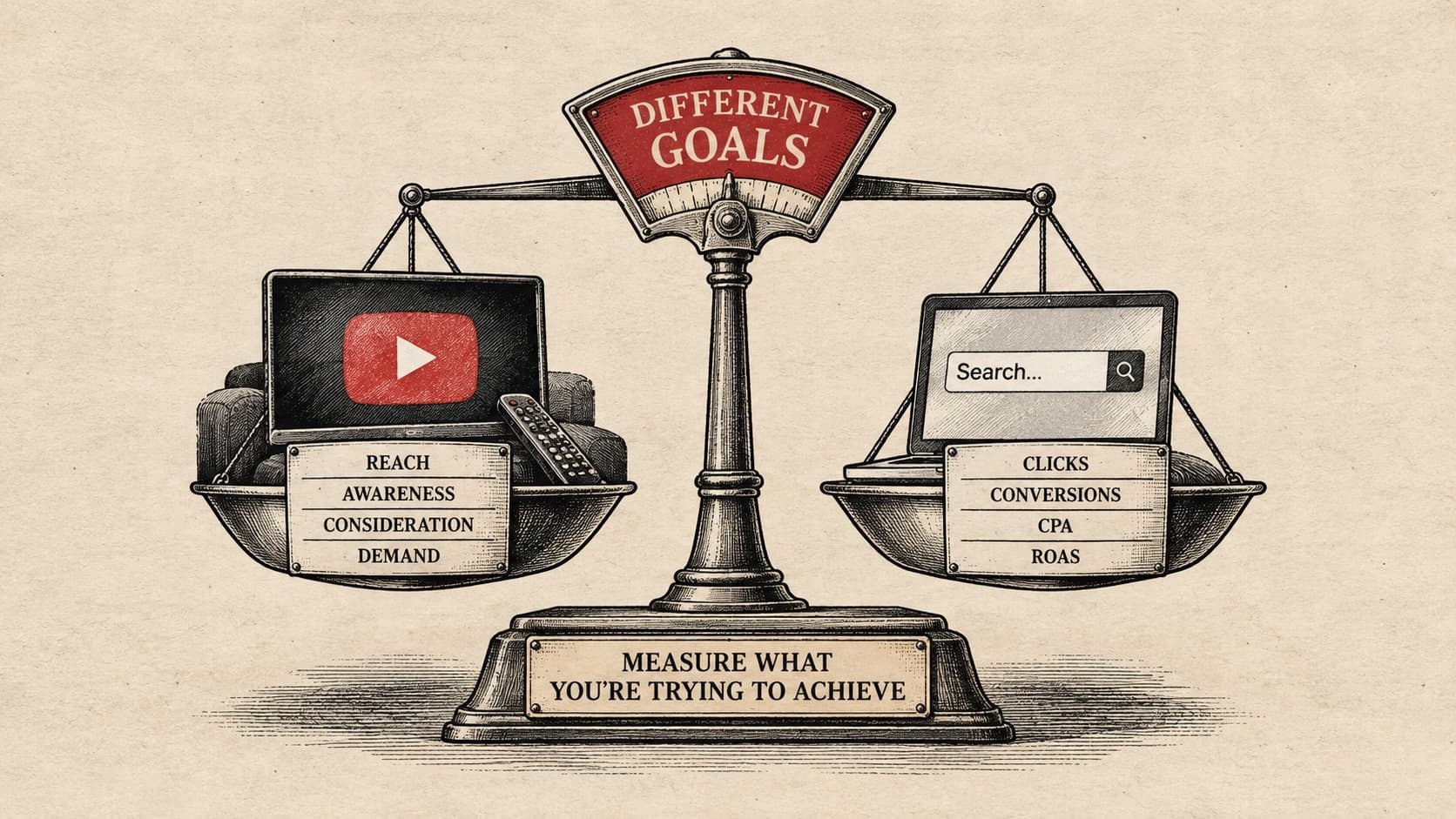
Paid search has trained us well.
Someone has a need, they search for something related to that need, they see an ad, click through and, hopefully, convert. We measure the conversion, calculate the CPA or ROAS and make decisions about what happens next.
The reality is obviously more complicated than that, but Search gives us an unusually neat relationship between existing intent, advertising and action. It has also helped establish a level of measurability that performance marketers have become accustomed to.
The problem comes when we carry exactly the same expectations into other channels.
YouTube is a good example. Launch a campaign, spend some money and it isn’t long before someone asks how many conversions it generated, what the CPA was and how that compares with Search. Search inevitably makes for a comfortable comparison because people were actively looking for something in the first place.
But should we expect someone watching a video to behave in the same way as someone who has just typed a relevant search into Google? And if not, why do we so often measure them as though they should?
Search captures intent. YouTube can operate before it
One of Search’s great strengths is its ability to capture declared intent. Someone needs car insurance, a new boiler, business finance or a hotel in Manchester and tells Google exactly that. We don’t have to create the initial interest. The searcher has already brought some with them.
YouTube can operate differently. It can introduce someone to a product or business they didn’t previously know about. It can make them aware of a problem or solution. It can build familiarity, influence consideration or reinforce a preference that eventually contributes to an action somewhere else.
That doesn’t make YouTube an exclusively “upper-funnel” channel. Depending on the campaign, audience and proposition, video can absolutely be expected to generate direct response as well. The point is that there isn’t one universal role for YouTube, so there shouldn’t be one universal definition of success.
Before deciding how a campaign should be measured, we need to establish what we’re actually trying to achieve.
YouTube isn’t one advertising environment
Even talking about “YouTube” as though it represents a single experience can be misleading.
Think about the difference between someone watching YouTube on their phone and someone watching it on a smart TV.
The first may be holding the device in their hand, able to click, search, browse or take action immediately. The second might be sitting several metres away from a 65-inch television, perhaps watching with other people in the room, or have the TV on in the background.
Then consider desktop or tablet viewing. Or YouTube Shorts, where a user is consuming vertical, short-form content and the next piece of content is a swipe away.
All of these can be described as YouTube advertising, but the context in which the advertising is consumed can be dramatically different.
Google’s own guidance reflects some of these differences. Shorts is described as a mobile-optimised, vertical, full-screen experience in which ads appear between organic Shorts and can immediately be skipped with a swipe. Its creative guidance recommends vertical, sound-on assets designed to feel “social first”, rather than simply treating Shorts as another place to distribute a conventional landscape video. (Google Help)
So if the viewing environment and behaviour can be different, should we automatically expect the response to be identical?
This is an area where my own thinking has evolved. I’ve run YouTube alongside substantial Search activity over the years, and I wouldn’t now be comfortable treating mobile, desktop and connected TV as though they’re simply different screens delivering the same advertising experience. Where scale allows, I’d want to understand those environments separately and consider whether the goal, creative and measurement should differ too.
Someone watching an advert on a television hasn’t suddenly become an unsuccessful website visitor because they didn’t click it.
This is where campaign planning and measurement need to become more considered.
The creative problem comes before the measurement problem
I’ve seen a familiar starting point many times over the years:
“We’ve got this video. Where else can we use it?”
YouTube gets added to the list. Perhaps the same asset gets repurposed for social. A vertical version is produced for Shorts. The dimensions have changed, so the creative is considered adapted for the channel. But there is a difference between making an asset fit a placement and creating something for the way people actually use that placement.
The better starting point is surely the opposite way around.
Where will someone encounter us? What are they likely to be doing at the time? How much attention can we reasonably expect? What action, if any, do we want them to take? And what creative gives us the best chance of achieving that?
A vertical crop of a landscape brand film might technically fit Shorts, but that doesn’t automatically make it good Shorts creative. Equally, something designed around an immediate mobile interaction might not be the asset we’d choose for someone watching on a television.
Google itself now allows creative preferences to anchor video assets to particular formats such as in-stream, in-feed or Shorts, further reinforcing the point that these environments don’t have to be treated as interchangeable containers for the same creative.
If the experience is different, the creative may need to be different. If the creative and expected behaviour are different, our expectations around measurement may need to be different too.
Audience targeting doesn’t make the question any simpler
Then we get to the audience. One of YouTube’s great strengths is the breadth of targeting possibilities available. It can also be one of the things that makes planning it confusing.
There are demographic options, affinity and in-market audiences, life events, detailed demographics, custom segments, first-party audiences, remarketing and automated approaches, among others. Shorts campaign guidance alone references affinity, in-market, custom segments, interests, detailed demographics and life events. (Google Help)
It’s possible to build something that looks incredibly sophisticated inside an advertising platform while still struggling to answer a much more basic question:
Why are these the people we want to influence?
More targeting options don’t automatically create a better targeting strategy. Again, it comes back to the goal. Who are we trying to reach? What do we currently know about them? What do we want to change or encourage? And what evidence would tell us whether that happened?
Those questions matter far more than how many targeting layers we can find in Google Ads.

The attribution trap
This is where comparing YouTube directly with Search becomes particularly problematic.
Imagine two simplified customer journeys.
- In the first, someone searches for your product, clicks your Search ad and converts.
- In the second, someone sees your YouTube ad, doesn’t click it and continues watching their video. Two days later they search for your business, click a Search ad and convert.
Look at that second journey through a predominantly click-led lens and Search has a very compelling story to tell. But we shouldn’t simply swing to the opposite conclusion and award the conversion to YouTube either.
Seeing an advert before converting doesn’t prove that the advert caused the conversion any more than failing to click it proves that it had no effect.
This is precisely why video measurement has developed beyond the click. Google explicitly says that people consuming video don’t always take action directly after viewing and provides engaged-view conversions to capture conversions following a qualifying video engagement without requiring an ad click. (Google Help)
There are other approaches too. Brand Lift is designed to measure areas including ad recall, awareness and consideration, while Search Lift compares search behaviour between groups exposed and not exposed to advertising to identify incremental search activity. These aren’t universally available to every advertiser, but their existence is important: even the platform selling the advertising recognises that clicks alone don’t describe the effect of video. (Google Help)
Depending on the scale, objective and business, we can also look at subsequent search behaviour, customer journeys, CRM outcomes, experiments and other evidence of incrementality.
The question isn’t simply which platform gets to claim the conversion. It’s whether the advertising changed an outcome that matters.
Start with the goal, then choose the KPI
This is the part that can easily get reversed. We launch a YouTube campaign, look at the metrics available in the interface and then decide which ones we’re going to report. Instead, we should be starting with the goal.
The principle is relatively simple:
The KPI should be a consequence of the goal, not a default inherited from the channel.
The KPI should be a consequence of the goal, not a default inherited from the channel.
Take specialist motor insurance, an area I’ve worked in extensively. Search is particularly effective at capturing existing intent. If somebody searches for “imported car insurance”, they’ve already identified both the need and, to some extent, the solution.
Now imagine the goal of the YouTube activity is different: reaching owners of relevant vehicles before they’ve actively started shopping for cover. I’d start by defining that goal and the audience, then consider where we’re likely to reach them. If Shorts is part of the plan, I’d want creative designed for that consumption environment rather than simply cutting down an existing landscape video. If connected TV is also important, I’d consider separating that activity where scale allows rather than assuming somebody watching on a television should demonstrate the same immediate behaviour as somebody holding a phone.
The measurement follows those decisions. I wouldn’t simply benchmark that activity against the CPA of a Search campaign capturing existing insurance demand. I’d establish upfront what evidence we’re looking for. That could include appropriate reach and frequency, engaged-view behaviour, subsequent relevant search activity where measurable, assisted or later conversions and, ultimately, customer outcomes.
And if none of those signals moves, “it’s upper funnel” isn’t a defence. The campaign still has to justify the investment.
Not measuring YouTube like Search doesn’t mean giving it a free pass
None of this is an argument for making YouTube less accountable. It’s an argument for making the accountability appropriate to what we’re actually trying to achieve.
For decades, businesses have spent significant amounts of money on television, radio, print, outdoor advertising, sponsorship and other channels without anything approaching the direct response data we’ve become accustomed to in digital advertising.
Nobody stood next to a billboard waiting for somebody to click it.
Digital advertising has arguably changed our expectations of measurability. Because Google Ads gives us a screen full of numbers, it’s tempting to demand the same type of measurable response from everything we buy through it.
The availability of a metric, however, doesn’t automatically make it the right metric. But we shouldn’t take that argument too far in the other direction either.
YouTube isn’t a newspaper advert. We have far more opportunities to understand what happened after someone encountered our advertising. We can measure reach and frequency, video engagement, engaged-view and view-through behaviour, conversions, subsequent search behaviour and, in appropriate circumstances, lift and incrementality.
Google even provides Brand Lift and Search Lift methodologies specifically because traditional click, impression and view metrics don’t answer every advertising question.
So neither extreme is particularly satisfactory.
“It didn’t generate enough last-click conversions, therefore YouTube doesn’t work” is too simplistic.
“It’s upper funnel, so you can’t really measure it” isn’t good enough either.
Not judging YouTube as though it were Search shouldn’t mean lowering the standard of accountability. If anything, it means doing the harder work of deciding what evidence should demonstrate that the investment made a difference.
Views aren’t automatically valuable. A low cost per view isn’t automatically efficient. Reach doesn’t pay the bills simply because we call something an awareness campaign.
Every pound still needs to earn its place.
Every pound must earn its place
Dez Calton (Precisionly, Founder)
We just need to make sure we’re using the appropriate evidence to decide whether it did.
What are we actually buying?
Perhaps this is the more useful question. With Search, we’re frequently buying access to declared intent. The customer tells us something about what they want through the query they type.
With YouTube, we might be buying attention, reach, familiarity, consideration, influence, demand or direct action. Sometimes several of those things will be happening together.
Even within YouTube, the answer can change according to the audience, format and viewing environment.
That’s why beginning with “we should run some YouTube ads” isn’t enough. Nor is beginning with an existing piece of video and looking for somewhere to distribute it.
Start with the goal. Think about the audience you need to reach and the environment in which you’ll reach them. Develop creative appropriate to that experience. Then decide what evidence would demonstrate that the campaign achieved what you asked of it.
Goal → Audience → Environment → Creative → Measurement.
Search has given performance marketers an extraordinary level of measurability. That’s one of its greatest strengths. But it doesn’t follow that the same measurement framework should become the ruler against which every other form of advertising is judged.
A YouTube Short watched on a phone, an in-stream ad encountered on a laptop and a video viewed on a television aren’t simply three opportunities to generate the same click.
- The audience can be different.
- The environment is different.
- The creative should probably be different.
- The expected behaviour can be different.
So start with the goal and measure accordingly.
YouTube doesn’t deserve a free pass because it’s video. Every pound still needs to earn its place. But before deciding whether it has, make sure you’re measuring what you actually asked it to achieve.