Retail is heading into Black Friday with bot traffic surging. Here's what to do to minimize wasted ad spend
AI Max campaigns went from the cleanest cohort in retail Search to the dirtiest in nine months. Here is what that means for your Black Friday budget.
Disclosure note: the data in this piece comes from *Lunio's 2026 Invalid Traffic Impact Report for Retail*, an analysis of 414 million ad clicks across 88 retail accounts.
TL;DR
New Lunio data covering 414 million retail ad clicks from Q4 2025 to Q2 2026 shows invalid traffic (IVT) rising in every quarter measured, with the sharpest deterioration inside AI Max campaigns.
From September, Google begins auto-upgrading eligible legacy Search campaigns to AI Max, which means a chunk of retail accounts will inherit that exposure weeks before Black Friday whether they opted in or not. The window to benchmark your traffic quality is now, while you still have a clean baseline to compare against.
Why the Q4 dashboard will lie to you
In this dataset, the holiday quarter was the cleanest quarter on paper. Q4 2025 recorded the lowest IVT rate of the whole period. Pretty counterintuitive, right?
Unfortunately, that reading falls apart the moment you look at absolute numbers. Invalid clicks held at roughly 6.6 million through Q4, then kept growing to 7.2 million by Q2 even as total traffic fell from its holiday peak.
The rate dropped in Q4 because millions of shoppers flooded the denominator, diluting a bot problem that never went anywhere.
The practical implication here is that if your invalid traffic (IVT) rate, your junk lead rate, or your bounce-heavy placement share improves in November, resist the urge to report it as a win (for now).
The invalid volume underneath is probably flat or rising, and it will resurface in January when real demand recedes. If you only monitor rates, build yourself a view of absolute invalid volume too. It is the number that actually maps to wasted budget.
Display shows the same mechanic in reverse, and more violently. Retail Display IVT went from 2.45% in Q4 to 8.13% in Q2, more than tripling in six months. Part of that is dilution unwinding.
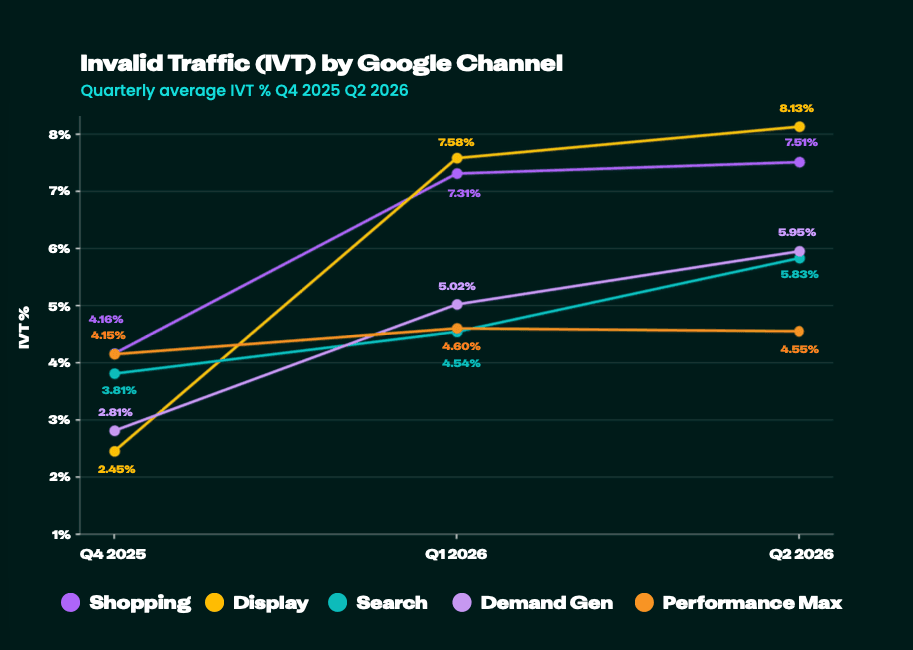
The other part of it is concentration. Display click volume contracted 68% as retailers pulled back post-holiday prospecting, leaving the remaining spend sitting disproportionately in always-on network inventory. Which brings us to where that inventory actually is, but first, the bigger story.
AI Max is the traffic quality story of the year
The most startling finding in the report is a like-for-like cohort comparison that holds almost everything constant. Retail Search campaigns with AI Max enabled versus retail Search campaigns without it. Same accounts, same sector, same nine months, same campaign type. The only structural difference is the feature being toggled on.
When retailers first switched AI Max on, their campaigns were markedly cleaner than standard Search: 2.46% versus 3.72% in Q4 2025. That is the opposite of what you'd expect if this were just careless advertisers flipping a toggle, and it cuts against the obvious selection-bias objection.
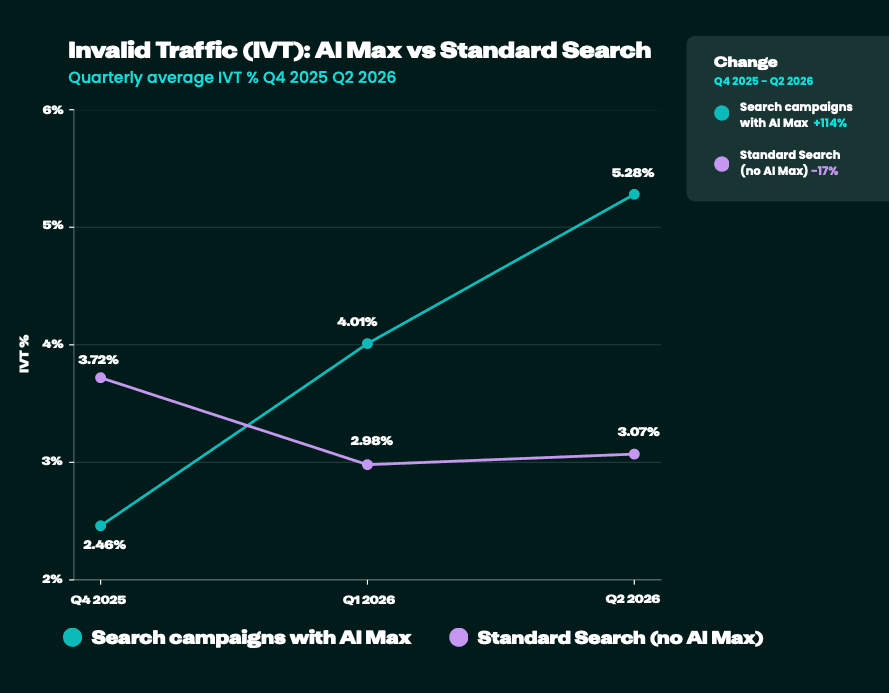
Then the picture inverted. AI Max campaigns more than doubled to 5.28% by Q2 2026, a 114% rise, while standard Search in the very same accounts drifted between 3.0% and 3.7% and actually ended the period lower than it started. By the end, AI Max carried an invalid rate 72% higher than standard Search, and accounted for 55% of all retail Search clicks but 68% of the invalid ones.
Mechanically this is exactly what the feature's design predicts. AI Max widens reach through keywordless matching and final URL expansion, pushing your ads into queries and pages you never explicitly chose.
The gap between the two cohorts is due to the cost of everything AI Max reaches that standard Search does not. Some of that reach is genuinely incremental demand you'd never have captured. Some of it is junk. The job is to weigh one against the other with real data from your own account, rather than assuming the expansion is clean.
Two caveats travel with this finding:
-
- It is observational, so adopters and non-adopters may differ in ways the analysis can't fully control for.
-
- And Google's own headline claim for AI Max (14% more conversions or conversion value at similar CPA/ROAS) is explicitly sourced from non-retail advertisers, so retail teams evaluating the feature sit outside the population that benchmark describes either way.
The reason this matters right now is the calendar. From September 2026, Google begins automatically upgrading eligible legacy Search campaigns to AI Max, including those using Dynamic Search Ads, automatically created assets, and campaign-level broad match. If you run any of those, you may be moved onto the feature in the weeks immediately before Black Friday, at the exact moment your budgets peak.

Shopping has earned prospecting-level scrutiny
Shopping is the campaign type most retailers treat as self-optimising infrastructure. Set the feed live, let automated bidding run, check ROAS weekly. The data suggests that trust is misplaced.
Shopping carried the highest average IVT of any Google channel at 6.33%, climbing from 4.16% to 7.51% across the period. By Q2, roughly one in thirteen Shopping clicks was invalid.
The structural explanation holds up. Feed-driven ads serve against high-intent product queries, which is precisely the traffic competitor scrapers, price-monitoring bots and affiliate arbitrage operations want.
One account-level example from the report makes the point sharply: a DTC footwear brand's primary branded Shopping campaign was carrying a 19.85% IVT rate, three times the account average. Given brand campaigns are absolutely vital during peak sales periods, this finding is concerning.
If you take one structural habit from this piece, make it this: put your Shopping campaigns through the same traffic-quality review cadence as your prospecting campaigns. Not because Shopping is broken, but because the assumption that it polices itself is doing a lot of unexamined work in most retail accounts.
A short pre-peak checklist
None of this requires a vendor to act on. Before budgets surge:
1. Check your AI Max exposure now. Identify campaigns using DSA, automatically created assets or campaign-level broad match, and decide deliberately whether you want them upgraded in September. If not, then you need to restructure before then.
2. Segment your search terms report by AI Max versus standard. If you're already running it, you need a view of what the expanded matching is buying you, in both directions.
3. Benchmark traffic quality before November, not after. Whatever measurement you use, a pre-peak baseline is the only way to interpret peak-season anomalies. Post-Q4 audits mostly tell you what you already paid for.
4. Track absolute invalid volume alongside rates. The Q4 dilution effect will otherwise hand you a false all-clear at the worst possible time. You can look at the invalid activity rates within Google’s own interface to track this. Or use an independent verification tool like Lunio to give a more granular view of your IVT exposure.
5. Review branded Shopping, not just generic. High-intent branded traffic is exactly what scrapers and arbitrage bots target.
The pattern across the whole dataset is that invalid traffic follows automation. The campaign types absorbing the most retail budget with the least placement visibility are the ones deteriorating fastest.
You cannot opt out of that trend, but you can walk into Q4 knowing what your traffic looked like before the surge, which is more than most of the sector will be able to say in January.
Read Lunio’s full Invalid Traffic Impact Report for Retail here.
Sources & Further Reading
- Lunio's Invalid Traffic Report for Retailhttps://www.lunio.ai/invalid-traffic-report-retail